Contents
Editorial
A reflection on the air traffic management industry
From strategy to implementation – CANSO’s high-level programme sets the pace in Lisbon
10 ways to make the most of your visit to Airspace World 2026

Fusion Technology at Airspace World 2026: Your Gateway to Gulf Aviation Opportunities
Yesterday at Airspace world
Press Releases
Theatre Highlights
Back page
Platinum Sponsors:
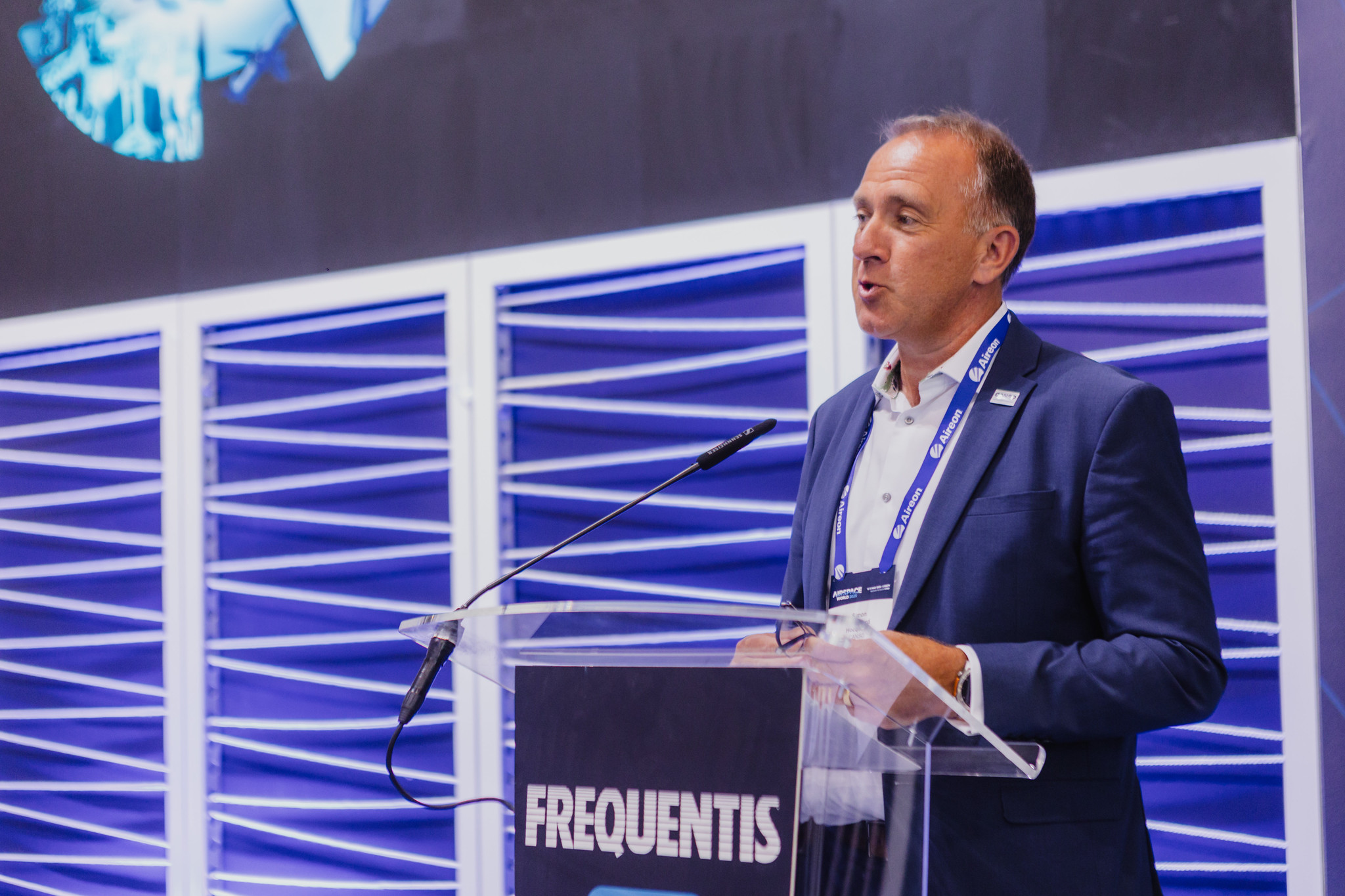
Welcome to Airspace World 2026, the world largest and most important gathering of the Air Traffic Management and wider aviation industry. Airspace World is the global stage for the airspace community, and by joining us here in Lisbon you are in the place where ANSPs, air traffic controllers and aviation innovators unite to shape the skies of tomorrow. In this special preview edition of Airspace World Today you can watch an exclusive interview with Simon Hocquard, President and CEO of your hosts, CANSO, in which he reflects on the current challenges and opportunities within the ATM industry. There are also exclusive looks at the theatre schedule for the week, as well as news about the app, details of how to navigate our exhibition floor, and tips on how to make the most of your time at Airspace World 2026.
19.05.2026
21.05.2026
21.05.2026
21.05.2026
Read full publication
Copyright © 2025
Platinum Sponsors:
Welcome from Simon Hocquard, President and CEO, CANSO
It is my great pleasure to welcome you to Airspace World 2026 in Lisbon — the global meeting place for the airspace management community.
Airspace World brings together the people, organisations, and ideas shaping the future of aviation. From air navigation service providers and industry innovators to regulators, manufacturers, policymakers, and new entrants, this is where our community comes together to collaborate, share knowledge, and drive progress.

As aviation continues to evolve at pace, the need for partnership, innovation, and global cooperation has never been greater. Across the industry, we are working collectively to build a safer, more efficient, and more sustainable future for airspace users around the world. Airspace World provides a unique platform to explore the challenges ahead, showcase new solutions, and strengthen the relationships that will help us achieve that ambition.

Over the coming days, I encourage you to make the most of every opportunity — to connect with colleagues, discover new perspectives, and contribute to the conversations shaping the future skies.
Thank you for being part of Airspace World 2026. I wish you an inspiring, productive, and enjoyable event.

Welcome from Agnes Krischik, Show Director, Airspace World
Welcome to Airspace World 2026 — the largest and most influential gathering for the global airspace management community.
This year’s event features an extensive exhibition, a dynamic conference and theatre programme, and countless opportunities to network, learn, and collaborate with industry colleagues from across the world. Whether you are here to discover the latest technologies, share expertise, explore partnerships, or help shape the future of aviation, we are delighted to have you with us in Lisbon.
To make the most of your experience, be sure to explore the Airspace World app, where you can plan your schedule, connect with attendees, arrange meetings, bookmark sessions, and navigate the exhibition floor with ease. With so much happening across the event, the app is the best way to stay connected and personalise your visit.
We also encourage you to take advantage of the many networking opportunities throughout the week — from conference sessions and industry discussions to receptions, meetings, and informal conversations across the show floor. Some of the most valuable moments at Airspace World happen when ideas, experiences, and perspectives come together.
And while you are here, we hope you also enjoy the unique atmosphere, culture, and hospitality of Lisbon — one of Europe’s most vibrant and welcoming cities.
On behalf of the entire Airspace World team and our partners, thank you for joining us. We wish you a successful and memorable Airspace World 2026.

Copyright © 2025
Platinum Sponsors:
In this exclusive video interview with journalist Graham Newton, Simon Hocquard, President and CEO, CANSO, talks about the current challenges and opportunities within the Air Traffic Management and wider aviation industry. Their conversation covers the current dynamic geopolitical environment, collaboration and agility, net zero targets and the challenges of recruitment.
Watch here
Copyright © 2025
Platinum Sponsors:
From strategic leadership conversations to in-depth operational discussions, CANSO’s high-level theatre programme at Airspace World 2026 will set the tone for the first half of the week — bringing together global leaders to address the realities of delivering modern, integrated airspace.
Proceedings begin on Tuesday morning with a flagship CANSO CEO Conversation in the Integra Theatre: ATM Modernisation Across Diverse Fiscal Models. Bringing together leaders from across the world, the session tackles one of the most fundamental — and often overlooked — challenges facing the industry: how transformation is funded in practice. With perspectives ranging from corporate ANSPs to state-funded systems, the discussion will explore how investment strategies, partnerships and financial frameworks are shaping the pace of modernisation.
This strategic lens quickly shifts into operational reality in the Frequentis Theatre with Operationalising Space Transport Operations in Shared Airspace. As launch activity accelerates, space operations are no longer theoretical — they are placing real-time demands on the airspace system. This CANSO-led panel brings together operators, regulators and ANSPs to explore how integration is already being managed today, and what must evolve to support safe, scalable operations.
Regional perspectives come to the fore in the Boeing Theatre with Airspace Modernisation in Latin America and the Caribbean – A Regional Path Forward. With ANSP leaders from across the region, the session explores how diverse capabilities and maturity levels can be aligned to deliver coordinated modernisation — from free route airspace and CNS upgrades to the integration of new entrants.
And Africa’s modernisation journey takes centre stage in CANSO Africa: Finding Pragmatic Approaches to Planning & Implementation – CATS and a Regional Path Forward. Bringing together industry leaders and stakeholders from across the continent, the session examines how harmonised planning, sustainable investment, transparent information-sharing and stronger collaboration can help accelerate progress towards seamless African skies. Using the CATS phases of Digital Information Sharing, Automation and Seamless Airspace as a framework, the panel will explore practical, scalable approaches that can be replicated across the region while continuing to improve today’s operational environment.
Safety and resilience remain central themes throughout the day. In the Integra Theatre, Working Together to Create a Collaborative Culture for Safe and Resilient Integrated Airspace examines how collaboration across civil, military and unmanned aviation stakeholders is essential to managing growing complexity. The session highlights the cultural, technological and regulatory shifts needed to move from reactive operations to proactive, system-wide resilience.
Digitalisation and collaboration take centre stage in the APAC-focused session How Digital Technology Can Enhance Regional Collaboration. Showcasing practical examples from across the region, the discussion explores how digital platforms are enabling more effective coordination, faster decision-making and scalable operational improvements.
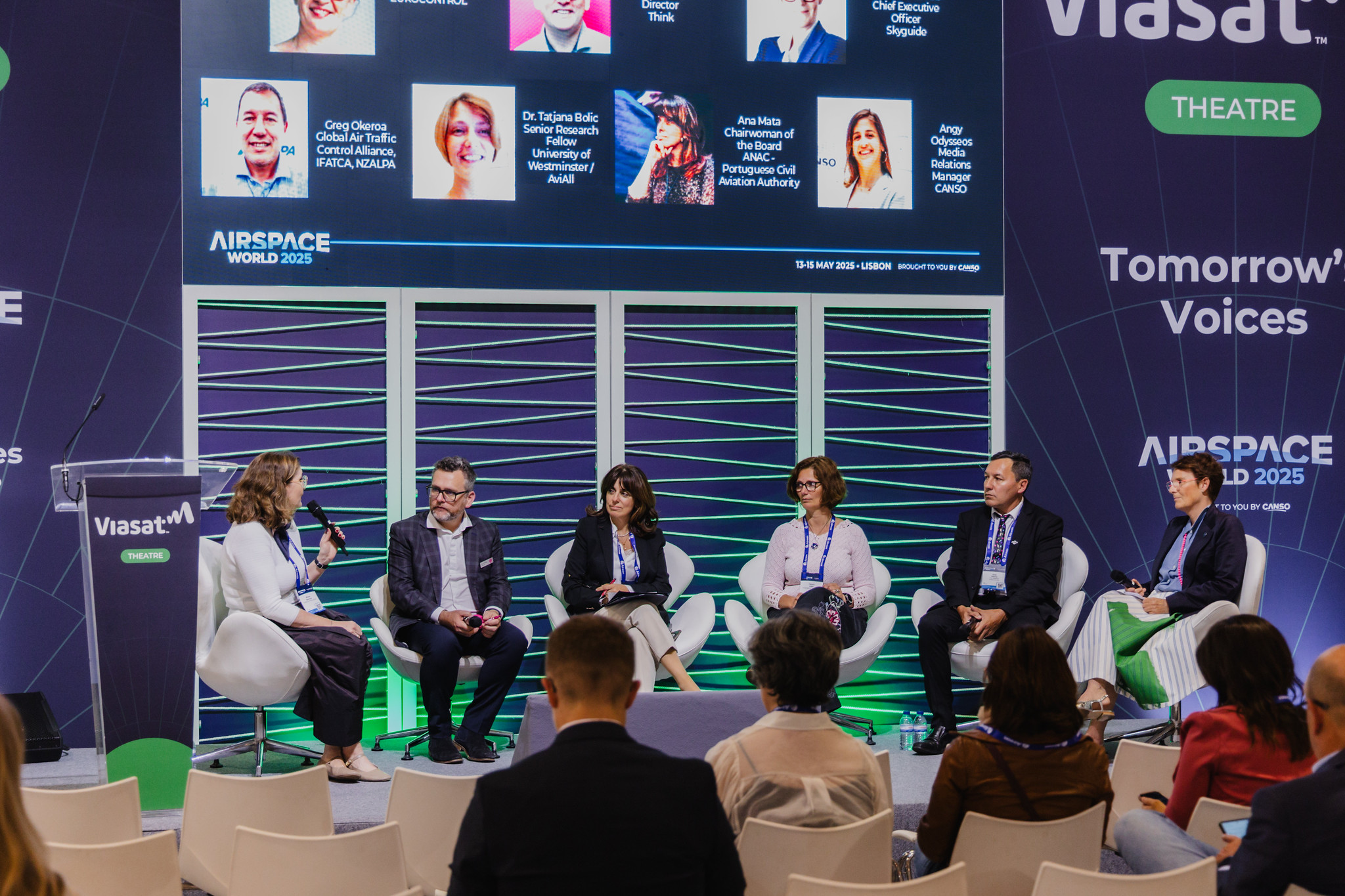
The industry’s future workforce is addressed through Tomorrow’s Voices: Building the Talent and Innovation Ecosystem Aviation Needs, bringing together perspectives from across training, research and operations. The session highlights how attracting, developing and retaining talent — alongside supporting innovation ecosystems — is becoming a strategic priority for the sector.
On Wednesday morning, the strategic narrative continues in the Boeing Theatre with a second CANSO CEO Conversation: Strengthening the Skies – Technology, Resilience and Civil-Military Collaboration in a New Geopolitical Era. Against a backdrop of increasing traffic demand and geopolitical uncertainty, the discussion explores how ANSPs can scale capacity, enhance resilience and integrate military requirements while maintaining performance across the network.
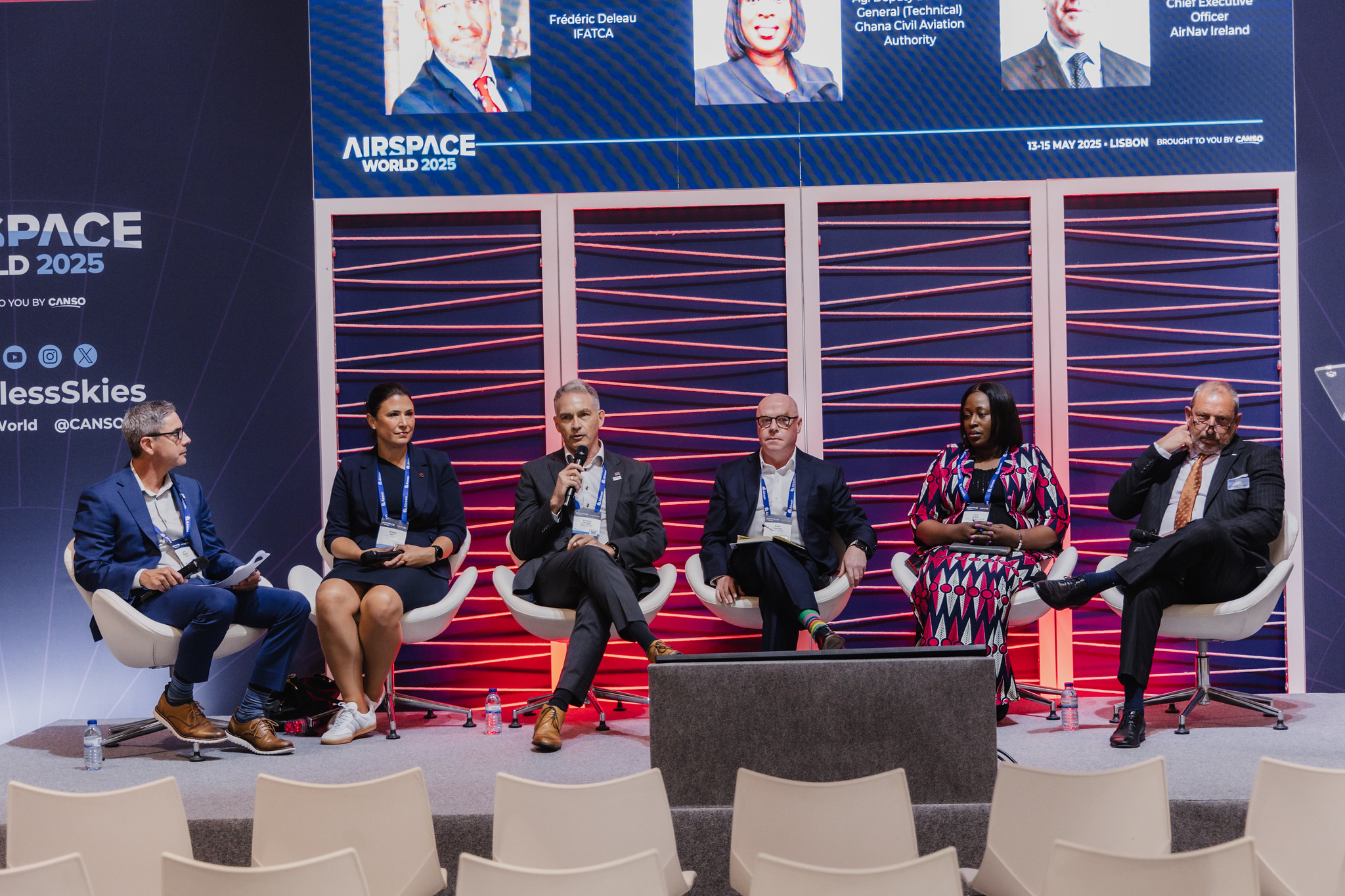
Also on Wednesday morning, in the Frequentis Theatre, Artificial intelligence and automation will also be under the spotlight with the fireside chat, What Will Be AI’s Role in Air Traffic Management? Airspace World's first all women panel of leading voices from across the ATM community, including operational, technology and human factors perspectives, will explore both the opportunities and challenges surrounding AI integration in aviation. From reducing controller workload and improving efficiency to questions around trust, safety and over-reliance on automation, the discussion will examine how the industry can strike the right balance between innovation and human expertise as AI becomes an increasingly prominent part of future airspace operations.
Together, these sessions form a coherent narrative — from funding and strategy through to operational integration, regional collaboration and workforce development — reflecting an industry moving decisively from ambition to implementation.
“What this first part of the programme shows very clearly is that transformation is no longer a theoretical discussion,” said Eduardo García, Manager Future Skies, CANSO. “We are seeing how different regions, operational environments and funding models are approaching the same challenge — how to modernise safely, sustainably and at pace. The value of bringing these perspectives together is in identifying what works in practice and how it can be scaled.”
Copyright © 2025
Platinum Sponsors:
From breakthrough technologies and operational insight to global networking and future-focused debate, Airspace World 2026 is designed to help the global airspace community connect, collaborate and shape the future of aviation. Download the Airspace World app, and use these 10 ways to get the most from your time in Lisbon.

The official Airspace World app allows you to build your profile, connect with attendees, message industry colleagues and arrange meetings in advance, helping you hit the ground running from day one.
With more than 150 conference sessions and multiple theatres running across the event, planning ahead is essential. Use the app to bookmark sessions, save meetings and create a schedule tailored to your priorities.
Watch how to do that on the Airspace World 2026 app here
This year’s conference theatre agenda focusses on the biggest issues facing the industry, from innovation, sustainability and automation to resilience, workforce development, drones, defence and integrated airspace operations.
See how to plan your conference schedule on the Airspace World 2026 app
Airspace World brings together ANSPs, airlines, airports, regulators, military representatives, technology providers, startups and emerging airspace users from across the world. Some of the most valuable conversations happen with people outside your usual network.
With more than 250 exhibitors and thousands of attendees, the exhibition is far more than a showcase — it is where partnerships are built, ideas are tested and future projects often begin. Plan which exhibitors you most want to meet before you arrive.
See all the exhibitors on the Airspace World 2026 app
While planning matters, some of the best moments at Airspace World come from spontaneous conversations, live demonstrations and chance introductions. Leave space in your schedule to explore, discover and follow interesting discussions.
Whether your focus is operations, safety, technology, strategy or policy, Airspace World offers a rare opportunity to hear perspectives from across the entire aviation ecosystem. Sessions outside your immediate area can often provide fresh ideas and unexpected inspiration.
Explore the conference schedule on the Airspace World 2026 app
Airspace World is not just about discussing the future — it is where future strategies, partnerships and approaches begin to take shape. Across panels, workshops and networking discussions, attendees have the opportunity to contribute directly to the conversations influencing tomorrow’s airspace.
Programmes such as Tomorrow’s Voices help bring students, graduates and early-career professionals into the heart of the event, creating opportunities for mentoring, recruitment and new perspectives on industry challenges.
From the Opening Reception to informal evening networking across the city, Airspace World extends well beyond the exhibition halls. Lisbon’s atmosphere, accessibility and hospitality make it the ideal setting for continuing conversations and building long-term industry relationships.
Copyright © 2025
Platinum Sponsors:
Written By Fusion Technologies

The Gulf region continues to lead major investments in aviation infrastructure, airspace modernisation, airport expansion, and advanced air traffic management technologies. As governments and aviation authorities accelerate the adoption of smarter and safer aviation systems, international technology providers increasingly require strong regional partners capable of supporting long-term operational success.
At Airspace World 2026, Fusion Technology proudly presents its growing role as a trusted aviation technology partner across Qatar and the wider Gulf region.
Headquartered in Qatar, with regional offices in the United Arab Emirates and Oman, Fusion Technology has established a strong track record in delivering complex aviation and airport infrastructure projects in collaboration with civil aviation authorities, military and civilian airports, and leading international OEMs.
Our role extends far beyond system integration. We help international technology providers successfully enter and expand within the Gulf market by combining local operational knowledge, regulatory understanding, project execution expertise, and long-term regional support.
We strongly believe that successful aviation projects in the Gulf require close collaboration between global OEMs and experienced local partners. While international manufacturers bring world-class innovation and advanced technologies, local companies contribute market access, stakeholder engagement, operational insight, and regional execution capabilities. This partnership model enables faster deployment, stronger customer confidence, sustainable support, and long-term business growth.
Over the years, Fusion Technology has successfully partnered with leading global organisations to deliver advanced aviation solutions across multiple operational domains.
One of our key ongoing projects includes the implementation of an Integrated Controller Working Position (ICWP) within an Advanced Surface Movement Guidance and Control System (A-SMGCS) for the Qatar Civil Aviation Authority (QCAA) in collaboration with Honeywell. This project will significantly enhance airport operational efficiency, situational awareness, and safety.
Fusion Technology has also supported the deployment and maintenance of critical surveillance and radar systems, including Surface Movement Radar (SMR) systems at Hamad International Airport and Doha International Airport in partnership with TERMA, as well as infrastructure support for S-Band Approach Radar systems in collaboration with Leonardo.
In the navigation domain, we contributed to the modernisation of airport infrastructure through the implementation of DVOR/DME systems and Category III Instrument Landing Systems (ILS) at Doha International Airport in collaboration with INDRA NAVIA. These systems support precision landing operations and improve safety during low-visibility conditions.
Our collaboration with Rohde & Schwarz included the deployment of VHF Direction Finder (VDF) systems to strengthen communication accuracy and airspace monitoring capabilities. In partnership with ENAV, Fusion Technology has also supported Air Navigation Service Provision initiatives, including airspace management, operational support, training, and certifications.
Beyond ATM systems, Fusion Technology continues to support large-scale airport infrastructure and enabling works projects across the region, including airfield ground lighting systems, aviation network infrastructure, and radar and mast installations. In support of airport operational readiness, we also provide ongoing flight inspection, calibration, and maintenance services for navigational aids, ensuring compliance with international aviation standards and maintaining optimum operational performance.
Innovation and safety remain central to our mission. At Airspace World 2026, Fusion Technology is demonstrating StratoCentral, our advanced GNSS Monitoring and Threat Detection platform designed to address the growing operational risks associated with GNSS interference, jamming, and spoofing.
As GNSS interference becomes an increasing operational reality across the aviation sector, StratoCentral provides real-time monitoring, detection, and threat analysis capabilities through a multi-layered architecture that combines terrestrial reference networks, ADS-B and AIS observations, and intelligent sensor fusion technologies. Supported by StratoNode multi-constellation and multi-band reference stations, the platform enables high-confidence detection while minimising false positives and maintaining operational trust.
Building on this detection capability, Fusion Technology’s four-layer GNSS Integrity and Security framework enables aviation stakeholders to detect, protect, continue, and integrate resilient Positioning, Navigation, and Timing (PNT) operations during GNSS degradation or denial events. The platform supports enhanced situational awareness, operational continuity, and improved incident investigation capabilities for airports and critical infrastructure environments.
Today, Fusion Technology continues to expand its regional presence and capabilities to better support aviation stakeholders across the Gulf. Our commitment is clear: to provide international partners with a reliable gateway to the Gulf aviation market while delivering advanced, future-ready solutions that contribute to safer, smarter, and more efficient skies.
Fusion Technology warmly welcomes all visitors, partners, aviation leaders, OEMs, and industry innovators to Airspace World 2026.
We invite you to visit our booth and discover how Fusion Technology is driving innovation across the Gulf aviation sector through advanced solutions, strategic partnerships, and next-generation airspace technologies. Join us to explore new opportunities for collaboration, innovation, and long-term regional growth.

Copyright © 2025
Platinum Sponsors:
Here's all the news you need to get you ready for Airspace World 2026
23.05.2026
21.05.2026
21.05.2026
21.05.2026
21.05.2026
21.05.2026
21.05.2026
21.05.2026
21.05.2026
21.05.2026
08.04.2026
Copyright © 2025
Platinum Sponsors:
Airspace World opens with a strong strategic tone across all five theatres, reflecting the industry’s shift from vision to delivery. But what defines Tuesday is not just ambition — it’s how that ambition unfolds across the day, from leadership priorities through to operational and technological implementation.
The day begins in the Integra Theatre with a flagship CANSO CEO Conversation: ATM Modernisation Across Diverse Fiscal Models (10:30–11:20). Bringing together global ANSP leaders, the session addresses one of the most fundamental challenges facing the industry — how transformation is funded in practice. From corporate to state-funded models, the discussion explores how investment strategies and financial frameworks are shaping the pace and scope of modernisation.
From there, attention shifts to the Boeing Theatre for The Role of the ATM Sector in the Strategic Outlook of European Aviation (12:00–12:50). Taking a system-wide perspective, the session positions ATM as a central enabler of capacity, sustainability and resilience, highlighting how closely aligned stakeholders must be as Europe navigates regulatory reform and growing demand.
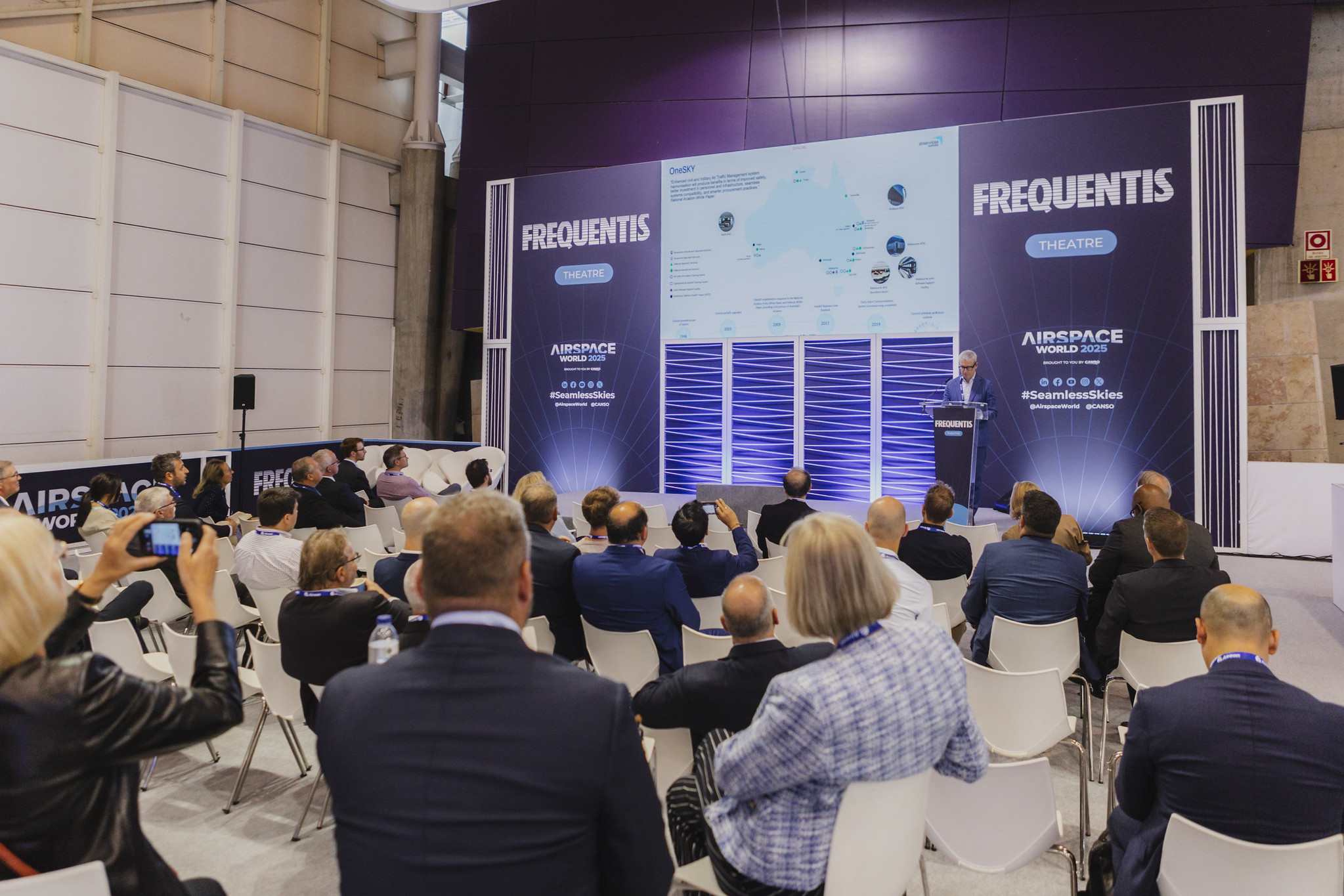
The early afternoon moves into operational delivery in the Frequentis Theatre with Operationalising Space Transport Operations in Shared Airspace (13:00–13:50). As launch and re-entry activity increases, this session explores how space operations are already being integrated into day-to-day airspace management. With input from operators, ANSPs and regulators, the focus is on real-world coordination, data sharing and the move toward more predictive, performance-based operations.
Later in the afternoon, the focus turns to collaboration and safety in the Integra Theatre with Working Together to Create a Collaborative Culture for Safe and Resilient Integrated Airspace (14:00–14:50). As airspace becomes more complex, the session explores how civil, military and unmanned aviation stakeholders can work together more effectively — and how cultural, regulatory and technological change must align to support safe, resilient operations.
The day concludes with a forward-looking perspective in the Viasat Theatre with EU’s Roadmap Towards the New Service Delivery Model (15:00–15:50). Focusing on Europe’s transition towards a more modular, digital and service-based ATM ecosystem, the session explores how cloud-enabled architectures, interoperability and new governance models will reshape how services are delivered in the years ahead.
Samantha Hawrysko, Airspace World Content Manager, said: “Tuesday is structured to reflect how transformation actually happens in practice — from strategic direction through to operational and technological delivery.
“What’s important is not just the individual topics, but how they connect across the day to show a coherent path towards integrated, future-ready airspace.”
As ATM modernisation takes a step forward towards digital transformation, the horizon of Trajectory-Based Operations (TBO) can only be accomplished through the synchronised efforts of ANSPs, airlines, and airports to implement the necessary infrastructure upgrades.
FF-ICE (Flight and Flow Information for a Collaborative Environment), the global ATM concept preceding SWIM and TBO, enhances flight planning thanks to interoperable, automated information exchanges provided by extended flight plans (eFPLs).
In 2022 Lufthansa achieved a major accomplishment in Air Traffic Management by performing the first flight ever supported by pre-flight 4D-trajectory data exchange in cooperation with Eurocontrol Network Manager and coordinated by SESAR Deployment Manager.
Now, ahead of the completion deadline established by CP1, ROMATSA, the Romanian Air Traffic Control Service Provider, has become the first air navigation service provider to implement the FF-ICE concept at operational level. This unique realisation positions Romania at the forefront of TBO.
Don’t miss SESAR Walking Tour 9 “From deployment to reality: Enabling TBO Through FF-ICE trajectory sharing” at Airspace World 2026 for a promising joint presentation from ROMATSA and Lufthansa on how collaboration among ATM stakeholders is key to make EU skies greener and smarter.
The official Airspace World 2026 app for is now available, giving attendees a smarter and more personalised way to plan their event experience ahead of the ATM industry’s largest global gathering in Lisbon.
Designed to support both networking and event planning, the app allows attendees to create their own profile, connect with industry colleagues, exchange messages and arrange meetings before and during the event. With thousands of aviation and airspace management professionals expected to attend, the platform helps visitors make valuable connections and maximise their time onsite.
The app also gives users full access to the extensive theatre programme, allowing attendees to browse sessions, bookmark those they want to attend and build a personalised agenda across the three-day event.
An interactive floorplan is also included, helping visitors easily navigate the exhibition halls, locate exhibitors and discover theatres, networking areas and key event features throughout the venue.
To help attendees get started, a series of short tutorial videos has also been released, providing step-by-step guidance on creating a profile, connecting with other attendees, arranging meetings and making the most of the app’s features.
Obtain your Airspace World pass
Make the most of your networking opportunities
Browse and bookmark the theatre agenda
See who is exhibiting at Airspace World 2026
“The app gives attendees the opportunity to start building connections before they arrive in Lisbon, plan their schedules in advance and navigate the event more efficiently once onsite,” said Agnes Krischik. “We encourage all attendees to download the app early and begin exploring everything Airspace World 2026 has to offer.”
The app is easily available on both Apple and Google Play (for Android) app stores (search Airspace World) or via these links:
There is also a desktop version available here.
Airspace World takes place in Lisbon from 26-28 May 2026 and will bring together the global ATM and wider aviation community for three days of exhibition, conference sessions, leadership discussions and networking.
From historic neighbourhoods and rooftop viewpoints to late-night music venues and hidden local favourites, Lisbon offers far more than conference halls and exhibition spaces. If you are extending your stay, or want ideas on how to spend a leisurely evening, here are 10 experiences worth adding to your Airspace World itinerary.
1. Wander the streets of Alfama
The oldest district in Lisbon remains one of its most atmospheric. Lose yourself among narrow cobbled streets, tiled buildings, hidden staircases and small bars tucked into historic corners. It is also the spiritual home of Fado, with live performances filling restaurants and taverns most evenings.
2. Take in the views from Lisbon’s miradouros
Lisbon is built on hills, and the city’s famous miradouros (viewpoints) are part of its magic. Popular favourites include Miradouro da Senhora do Monte and Miradouro de Santa Catarina, particularly at sunset with a drink in hand.
3. Explore Belém and its riverside landmarks
Home to some of Portugal’s most famous historic sites, the Belém district combines grand architecture, riverside walks and legendary custard tarts from Pastéis de Belém. Highlights include Belém Tower and Jerónimos Monastery.
4. Ride Tram 28 — at least once
Yes, it is touristy — but for good reason. The iconic yellow tram rattles through many of Lisbon’s most beautiful neighbourhoods and offers one of the best introductions to the city’s steep streets and daily life.
5. Discover Lisbon after dark
Lisbon’s nightlife is wonderfully varied. The Bairro Alto district is packed with lively bars, while venues such as Hot Clube de Portugal offer intimate late-night jazz sessions. Karaoke fans will also find plenty of energetic bars around Cais do Sodré and Bairro Alto, often running well into the early hours.
6. Experience an evening of live Fado
Even if you do not understand the lyrics, the emotion of Fado is unforgettable. Small venues in Alfama and Bairro Alto often provide the most authentic experiences, with candlelit rooms, Portuguese wine and haunting live music.
7. Visit LX Factory for a different side of Lisbon
Set beneath the 25 de Abril Bridge, LX Factory has transformed an old industrial complex into a creative hub of cafés, bars, bookshops, restaurants and street art. It is ideal for a slower afternoon away from the busiest tourist areas.
8. Find hidden corners in Graça
Less polished than central tourist districts, Graça offers a more local feel, with relaxed cafés, quieter viewpoints and traditional neighbourhood charm. It is a great place to escape the crowds while still enjoying incredible city views.
9. Eat seafood — slowly
Portuguese cuisine deserves time. Whether it is grilled sardines, octopus rice, garlic prawns or fresh cod dishes, Lisbon is one of Europe’s great seafood cities. The best meals are often the longest ones.
10. Simply spend time by the river
One of Lisbon’s greatest pleasures is its atmosphere. Walk the waterfront near Praça do Comércio, stop for a drink beside the Tagus River and enjoy a city that feels both energetic and relaxed at the same time.
From breakthrough technologies and operational insight to global networking and future-focused debate, Airspace World 2026 is designed to help the global airspace community connect, collaborate and shape the future of aviation. Download the Airspace World app, and use these 10 ways to get the most from your time in Lisbon.
1. Start networking before you arrive
The official Airspace World app allows you to build your profile, connect with attendees, message industry colleagues and arrange meetings in advance, helping you hit the ground running from day one.
2. Build your own personalised agenda
With more than 150 conference sessions and multiple theatres running across the event, planning ahead is essential. Use the app to bookmark sessions, save meetings and create a schedule tailored to your priorities.
Watch how to do that on the Airspace World 2026 app here
3. Explore the conversations shaping future skies
See how to plan your conference schedule on the Airspace World 2026 app
4. Step outside your usual bubble
Airspace World brings together ANSPs, airlines, airports, regulators, military representatives, technology providers, startups and emerging airspace users from across the world. Some of the most valuable conversations happen with people outside your usual network.
5. Use the exhibition floor strategically
With more than 250 exhibitors and thousands of attendees, the exhibition is far more than a showcase — it is where partnerships are built, ideas are tested and future projects often begin. Plan which exhibitors you most want to meet before you arrive.
See all the exhibitors on the Airspace World 2026 app
6. Make time for the unexpected
While planning matters, some of the best moments at Airspace World come from spontaneous conversations, live demonstrations and chance introductions. Leave space in your schedule to explore, discover and follow interesting discussions.
7. Attend sessions beyond your speciality
Whether your focus is operations, safety, technology, strategy or policy, Airspace World offers a rare opportunity to hear perspectives from across the entire aviation ecosystem. Sessions outside your immediate area can often provide fresh ideas and unexpected inspiration.
Explore the conference schedule on the Airspace World 2026 app
8. Take part in shaping industry thinking
Airspace World is not just about discussing the future — it is where future strategies, partnerships and approaches begin to take shape. Across panels, workshops and networking discussions, attendees have the opportunity to contribute directly to the conversations influencing tomorrow’s airspace.
9. Connect with the next generation
Programmes such as Tomorrow’s Voices help bring students, graduates and early-career professionals into the heart of the event, creating opportunities for mentoring, recruitment and new perspectives on industry challenges.
10. Enjoy Lisbon and the wider event experience
From the Opening Reception to informal evening networking across the city, Airspace World extends well beyond the exhibition halls. Lisbon’s atmosphere, accessibility and hospitality make it the ideal setting for continuing conversations and building long-term industry relationships.
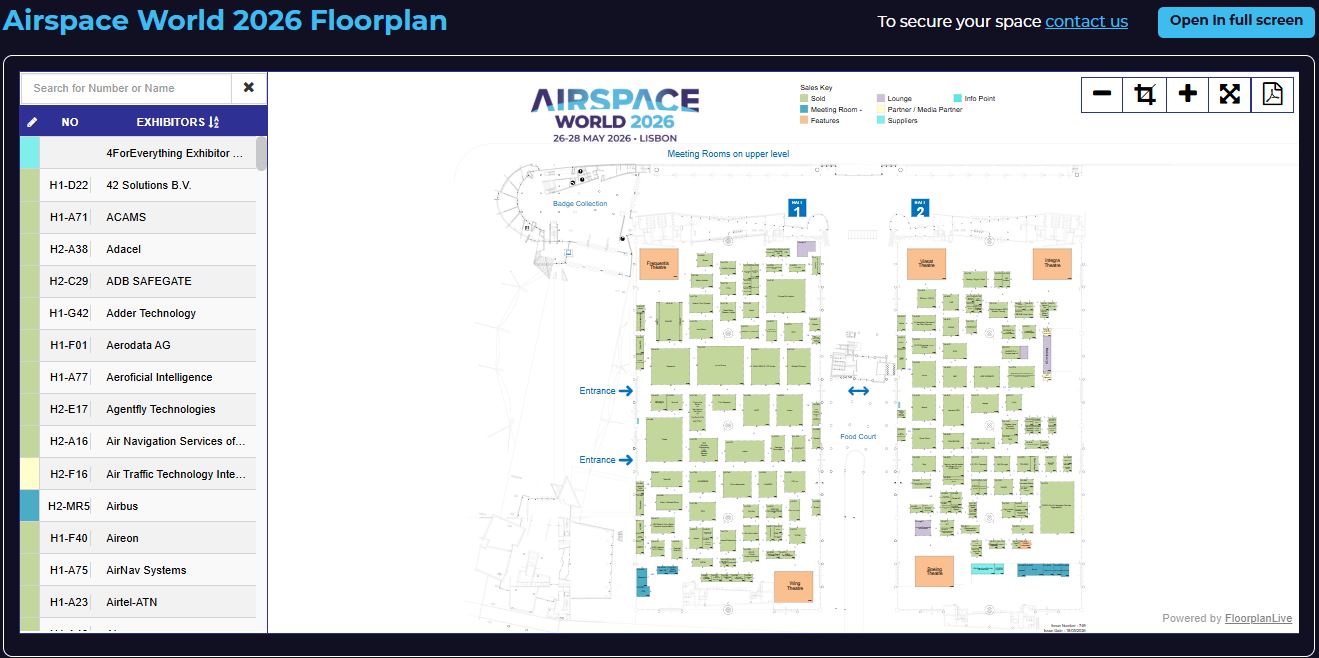
With over 200 exhibitors and over 20,000 square metres of floor space, there is plenty to see and explore at Airspace World 2026. And to help attendees find their way around, both AirspaceAsiaPacific.com and the Airspace Asia Pacific App have fully interactive guides to our exhibitors and exhibition hall.
To see exactly who is exhibiting at the show, use the Exhibitors section of the event website. Here you’ll find the full list of organisations at Airspace World 2026, each with a description of who they are and what they do. The list is alphabetical, but you can also search for an exhibitor by name. Especially useful is the ability to filter exhibitors by industry type or specialisms, showing you exactly who is there to meet any specific area attendees are investigating.
And then, to find a specific exhibitor, go to the Airspace World 2026 floor plan. The plan allows you to click on each exhibitor (listed alphabetically on the left hand side of the page) to then see exactly where they are in the hall as their stand is highlighted on the plan.
The global airspace community will come together at Airspace World 2026 for the inaugural Seamless Skies Awards Ceremony, taking place on Tuesday 26 May at 16:00 in the Boeing Theatre. The event will celebrate the organisations, partnerships and individuals driving innovation, collaboration and operational excellence across global air traffic management and the wider airspace ecosystem.
Delivered by CANSO in partnership with Global Airspace Radar and Unmanned Airspace/Urban Air Mobility News, the Seamless Skies Awards recognise achievements spanning safety, sustainability, resilience, digital transformation, lower airspace integration and workforce development. Winners will be announced live during the ceremony, before industry leaders gather for a post-awards drinks reception immediately afterwards.
The ceremony will also see the presentation of the new CANSO Person of the Year Award, introduced for 2026 to recognise an individual who has delivered an exceptional contribution to the airspace industry. Nominated and voted for by CANSO Members, the award highlights leadership, innovation and commitment helping to shape the future of global ATM.
Simon Hocquard, President and CEO, CANSO, said: “The Seamless Skies Awards highlight the innovation, collaboration and commitment that define our industry at its best. These awards recognise the people and organisations helping to shape a more connected, resilient and sustainable aviation system for tomorrow.”
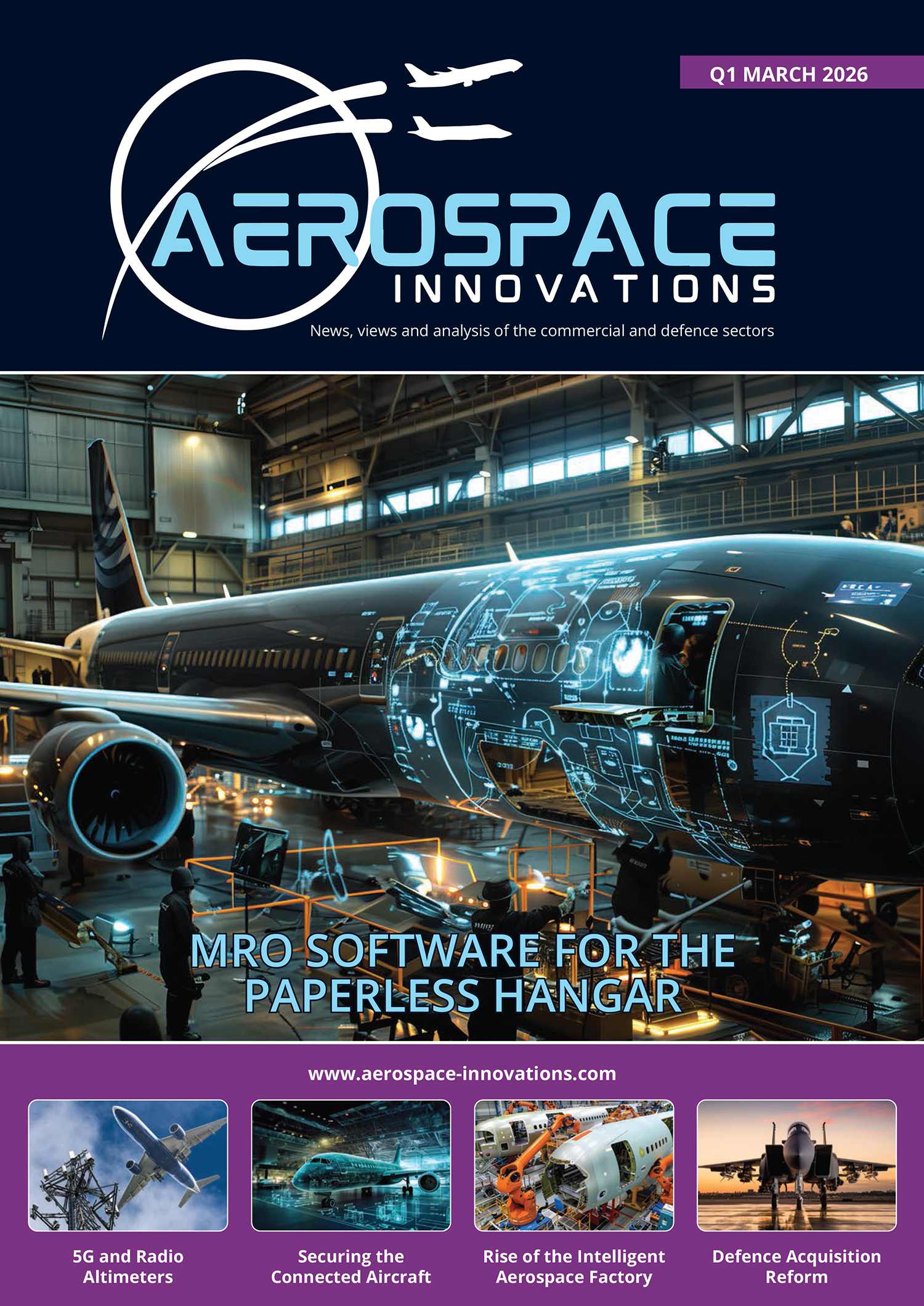
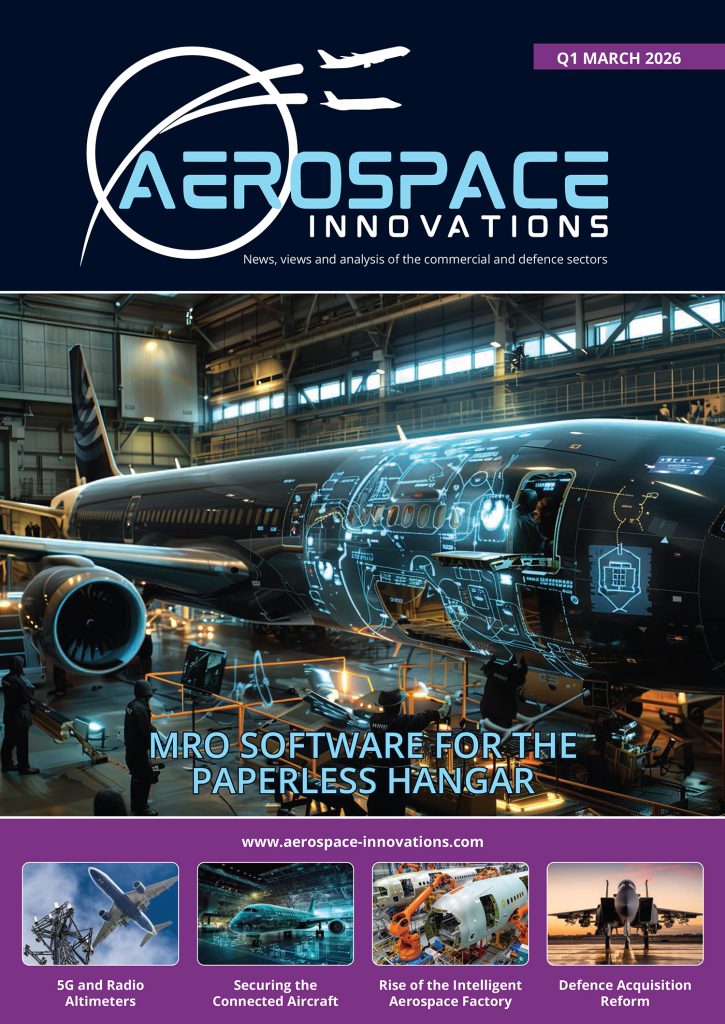
Aerospace Innovations® is the exciting publication for senior and middle management aerospace engineers, technical staff and pilots working in the commercial aviation, and aerospace and defence industries.

Founded in 2024, Aerospace Innovations® has quickly established itself as the leading magazine specialising and dedicated to exploring the technologies, ideas, and strategies driving transformation across the aerospace ecosystem. With a strong focus on innovation, it delivers in-depth coverage of next-generation developments influencing aircraft design, operations, and maintenance (MRO), as well as air traffic management, the rapidly evolving advanced air mobility (AAM) sector and the digital sky.
Backed by more than 45 years of combined industry experience, the founders have assembled a team of respected aviation journalists—including Alex Preston, James Careless, Mark Robbins, and Ian Harbison—alongside expert contributors from across the sector. Together, they provide authoritative analysis, thought leadership, and exclusive insights.
Published quarterly in both print and digital formats, to over 100,000 industry professionals, Aerospace Innovations® covers news, views and analysis connecting its audience with the latest technological advances being developed, tested, and deployed across commercial, military, rotary-wing, business aviation, and emerging aerospace markets. The main subject areas the magazine focuses on include Avionics, Testing, Connectivity, MRO, Operations and Sustainability.
Aerospace Innovations is also Flagship Media Partner for Avionics & Testing Innovations conference and exhibition, as well as Media Partner to Airspace World.
Learn more about advertising and sponsorship opportunities by contacting Simon Barker, Publisher & Sales Director, at simonb@aerospace-innovations.com.
Latest news, features, back issues and webinars can be viewed at www.aerospace-innovations.com.

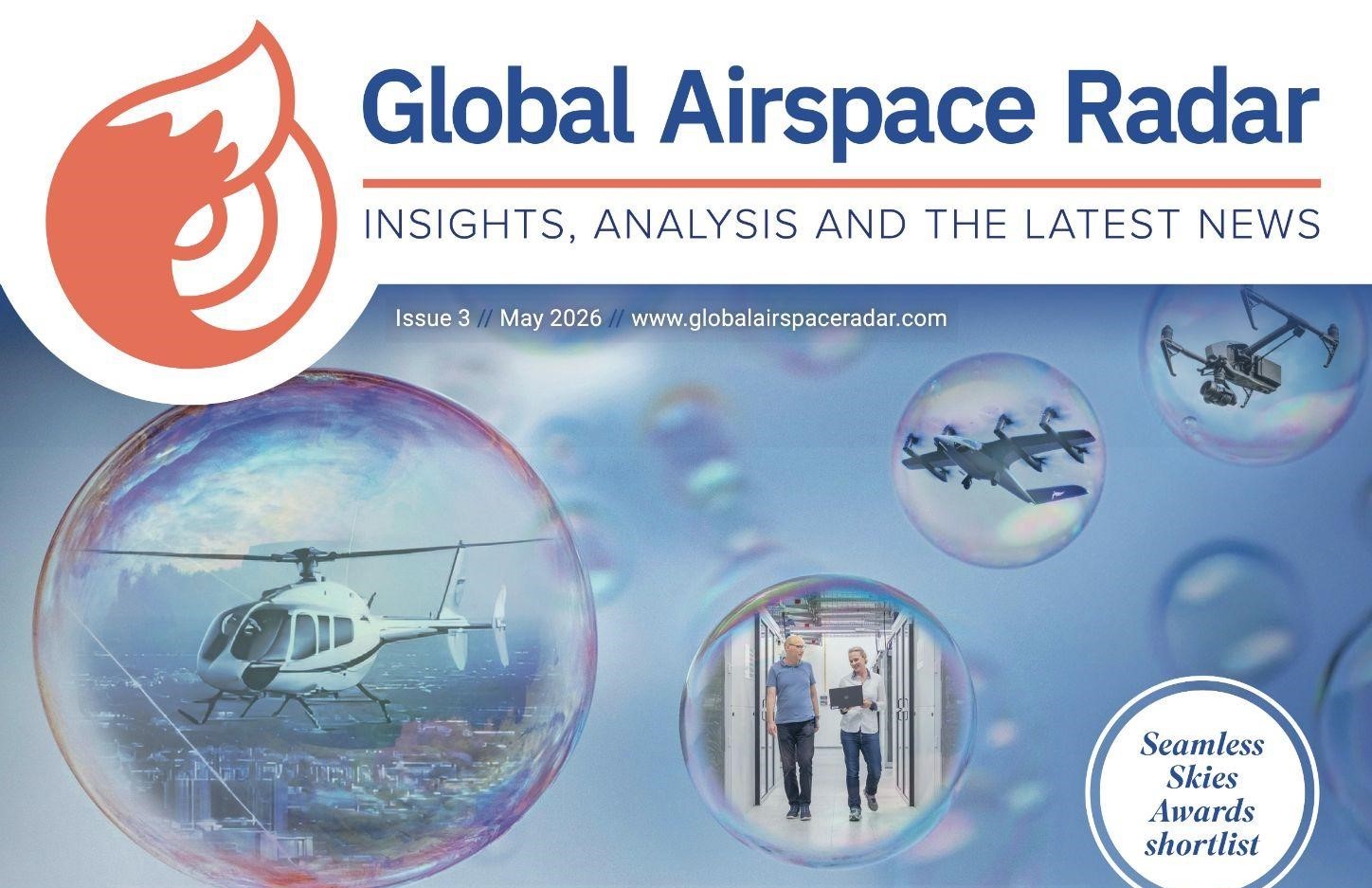
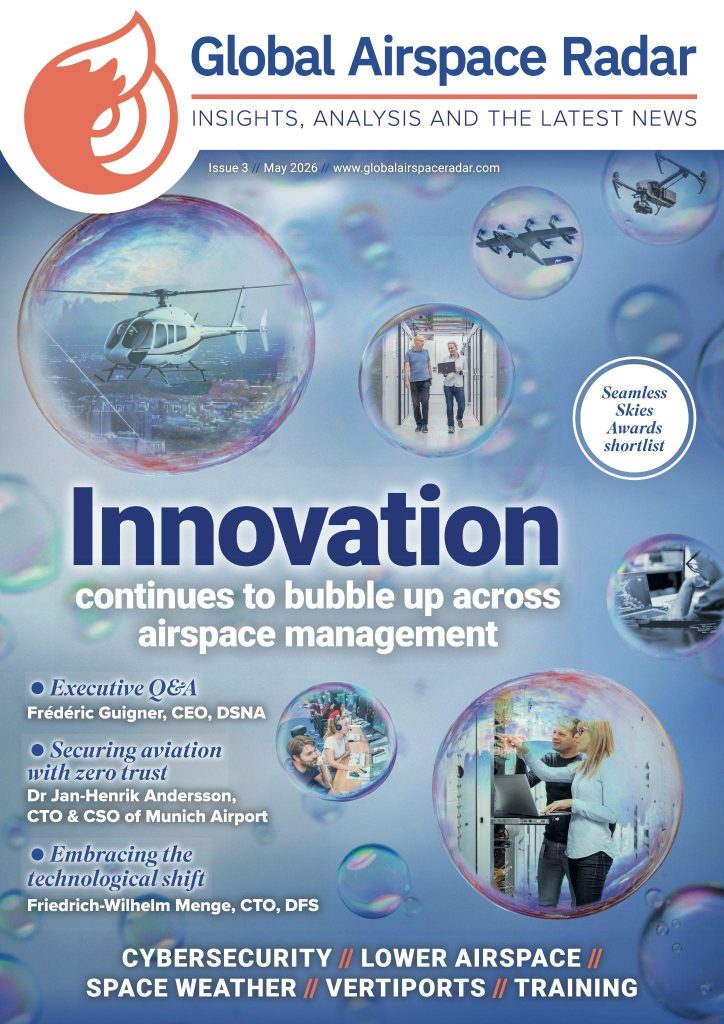
The Global Airspace Radar website was launched on 2 February 2025, followed by the first issue of the print magazine distributed at that year’s Airspace World. The ambition of the editorial team of four experts is to cover the airspace industry from all angles and over multiple channels:
Print or digital? Actually, both!

The last channel is the print magazine – available online and for download too . There are two issues per year and the next one will be available digitally in mid-May and in print during Airspace World, Lisbon.
Why such a magazine in the digital age? The team believes there is space for a publication covering all the aspects of the industry, with a long-term focus. Writing for a magazine published twice a year forces the editors and contributors to take a step back from the daily business and look at trends on a longer scale, going away from endless scrolling and short attention spans.
The articles can also be illustrated in a nicer way than on simple web pages – hat tip to our graphic designer – and the whole reading experience is different. The paper edition is like the cherry on top: a nice object, providing a pleasant time reading and the airspace industry deserves such a publication. Get one at Airspace World and let us know what you think.
Covering everything Airspace
Airspace usage changes, with drones being integrated into the lower airspace but also high-altitude platforms and space launches becoming more common. The newcomers are here to stay and Advanced Air Mobility is next in line. Global Airspace Radar looks at all airspace users and how they interact and impact each other.
Thanks to its team of editors, Global Airspace Radar covers all aspects of the industry and offers stories to all stakeholders, from air traffic controllers to decision makers, engineers, researchers, policy makers, and military players.
Apart from news, the website also lists industry events, jobs, and the latest addition is the training page with news related to training and a list of training courses.
Contribute and share your news
The readership is global, with a focus on Europe. 30% of readers are working for air navigation services providers, the rest being from the industry, research, regulatory bodies. 8.000 unique visitors come to Global Airspace Radar monthly and more than 7.500 follow the Linkedin page.
Reach out to editor@globalairspaceradar.com to share your news or discuss a potential contribution.
All the resources are free for readers. Global Airspace Radar is funded by sponsors who get visibility in the industry through all the channels mentioned above. Contact vincent.lambercy@globalairspaceradar.com to learn more about advertisement opportunities.
Portugal’s food scene is hearty, comforting and full of flavour, with seafood, slow-cooked dishes and sweet pastries all playing a starring role. If you are visiting Lisbon for , here are five classic dishes worth seeking out between conference sessions and networking events.
1. Pastéis de nata
Portugal’s famous custard tart is an essential Lisbon experience. Best enjoyed warm with cinnamon and icing sugar, these flaky pastries are found all over the city, although many visitors make a pilgrimage to Pastéis de Belém for the most famous version.
2. Bacalhau à Brás
Salt cod is deeply woven into Portuguese cuisine, and Bacalhau à Brás is one of the country’s best-loved dishes. Made with shredded cod, onions, crispy potatoes and egg, it is rich, comforting and appears on menus throughout Lisbon.
3. Grilled sardines
Simple, smoky and unmistakably Portuguese, grilled sardines are a Lisbon staple, particularly in summer. Usually served with potatoes, salad or rustic bread, they are at their best in traditional neighbourhood restaurants or during local street festivals.
4. Prego steak sandwich
A favourite late lunch or post-night-out option, the prego is a garlic-marinated steak sandwich served in crusty bread, often with mustard or piri-piri sauce. It is simple but extremely satisfying after a long day exploring Lisbon.
5. Seafood rice
Known locally as Arroz de Marisco, this rich seafood rice dish sits somewhere between a risotto and a stew. Packed with prawns, clams and shellfish, it is one of the best ways to experience Portugal’s love affair with Atlantic seafood.
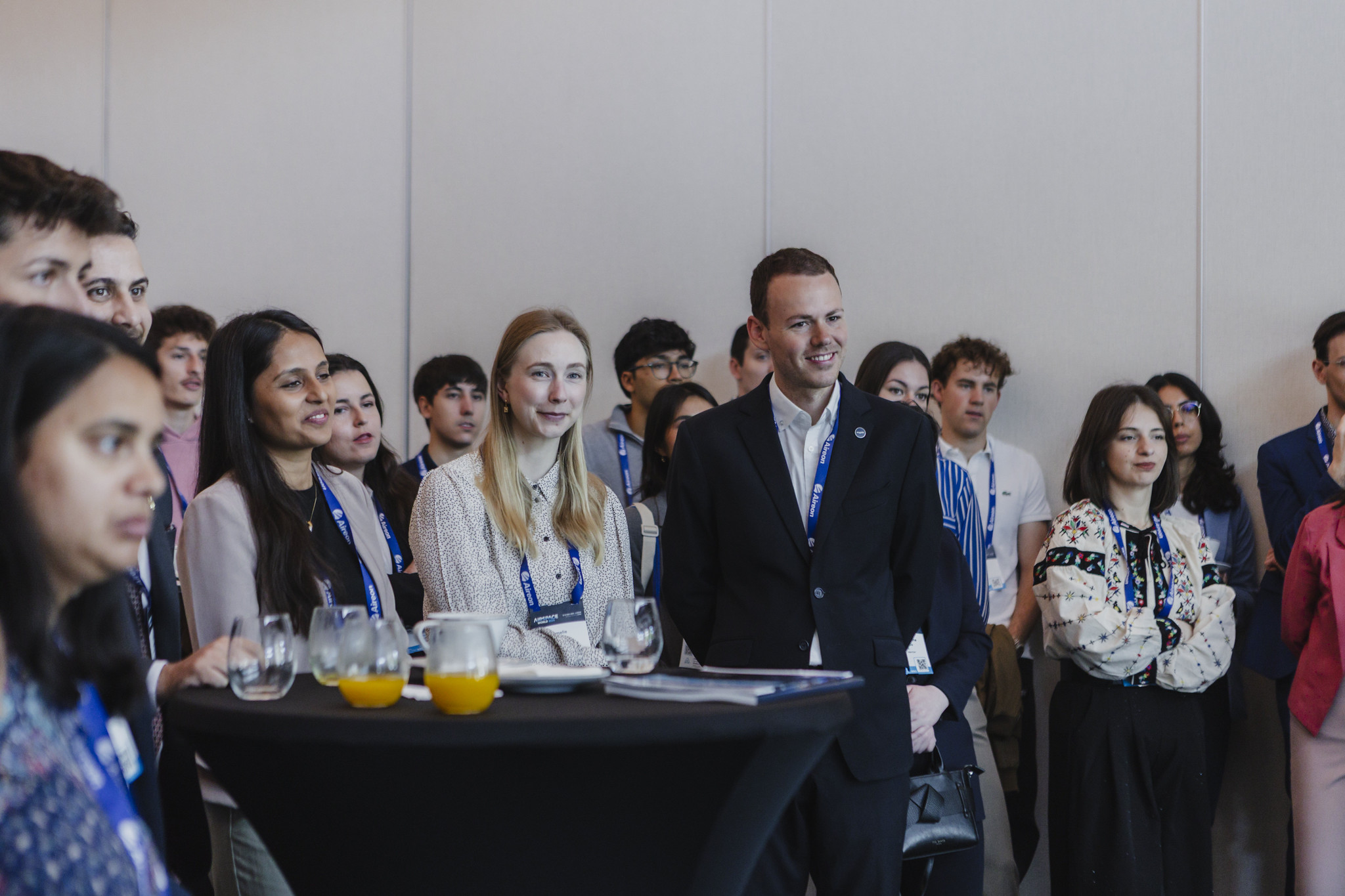
CANSO's Tomorrow's Voices programme kicks off this week at Airspace World in Lisbon, bringing together aviation leaders and emerging professionals for a series of discussions and networking activities on Tuesday 26 and Thursday 28 May.
What's Happening This Week
On Tuesday 26 May, the Tomorrow's Voices panel takes place from 15:00–15:50 at the Integra Theatre. The session explores how organisations across the aviation ecosystem are addressing talent attraction, retention, and skills development. The panel, moderated by Angy Odysseos (CANSO), will feature insights from Benjamin Fichtner (IFATCA), Grzegorz Knast (PANSA Training Academy), Marina Morić (Croatia Control), Michael McCormick (Embry-Riddle Aeronautical University), Patricia Lopez de Frutos (CRIDA), and Sabína Dobiašová (Integra Consult A/S). Through real-world examples, speakers will share initiatives that are delivering results today, offering practical insights the audience can adapt to their own organisations.
The main event is then on Thursday 28 May, with the CEO and Young Professionals' Breakfast (08:30–10:15) at the Feria Internacional de Lisboa Conference Centre. The morning begins with informal table conversations between young professionals and the participating CEOs, followed by a moderated panel discussion. This year's breakfast is kindly sponsored by Tern Systems Hungary.
Participating CEOs include:
Also on Thursday, the Interactive Exhibition Tour and Networking Game (11:00–12:30), organised and hosted by Engage2 and EUROAVIA, offers participants a guided exploration of the exhibition floor, with opportunities to engage with industry experts in cybersecurity, AI, UAS operations, and airspace management. The top two participants on the leaderboard will win travel grants to the Engage 2 Summer School in Trieste.
Get involved
For Tomorrow's Voices participants: Those that have already registered for the initiative will receive separate confirmation details. Those that haven't and would like to take part can find out more and register at airspaceworld.com/tomorrows-voices
Any exhibitors or organisations who are are interested in supporting the next generation of aviation professionals should contact press@canso.org.
The shortlist for the Seamless Skies Awards 2026 has been announced, recognising the organisations, initiatives and individuals driving innovation, collaboration and performance across global airspace management.
Delivered by CANSO in partnership with Global Airspace Radar and Unmanned Airspace/Urban Air Mobility News, the awards celebrate excellence across the ATM and UTM sectors, highlighting achievements in safety, efficiency, sustainability and the integration of new airspace users.
In each category, the shortlisted nominees are:
Building the lower airspace economy
Collaborative operations for sustainable skies
Innovation to enable safer, more efficient operations
Remarkable people & workforce
Safety, security & resilience
Seamless Skies for All
Simon Hocquard, President and CEO, CANSO, said: “The Seamless Skies Awards highlight the innovation, collaboration and commitment that define our industry at its best. This year’s shortlist showcases the breadth of work taking place across the global ATM community to enhance safety, improve performance and prepare our skies for the future. These finalists are not only delivering results today, but helping to shape a more connected, resilient and sustainable aviation system for tomorrow.”
Winners will be announced at the Seamless Skies’ Awards Ceremony at Airspace World 2026 in Lisbon, where the global ATM community will come together to celebrate those leading innovation across the skies.
Copyright © 2025
Platinum Sponsors:
Lisbon, Portugal, Monday 25 May 2026 – Over 300 senior aviation leaders convened today at the Myriad Crystal Centre in Lisbon for the CANSO Leadership Summit 2026, the official opening event of Airspace World 2026. The Summit brought together chief executive officers and senior representatives from CANSO Member organisations, regulatory bodies, and global aviation stakeholders for a day of strategic dialogue focused on translating vision into operational reality.
Under the theme "From Vision to Delivery – Skies in Transition," the CANSO Leadership Summit 2026 explored how ambitious global visions for the future of aviation are being translated into concrete actions, investments, and meaningful operational change across the air traffic management (ATM) industry.
The morning commenced with a warm welcome and statement from Tim Arel, CANSO Chair of Board of Directors, followed by Simon Hocquard, CANSO President and CEO, who delivered a comprehensive state of the industry presentation.
During his opening remarks, Simon said: “Systems do not transform themselves, people lead that transformation. As leaders in this room, your role is not just to respond to change, but to shape how your organisations navigate it. Creating clarity in complexity, proactively driving collaboration, investing in people, embracing agility, and thinking beyond traditional boundaries."
This set the stage for the keynote address by Kiko Dontchev, Vice President of Launch at SpaceX, who offered a unique perspective on translating bold vision into real-world delivery at scale – insights equally applicable to the global ATM transformation.
The centrepiece of the Leadership Summit was a high-level Global Panel: From Vision to Global Deployment, moderated by Mark Pilling, Managing Editor at Aviation Week Network. The panel brought together a diverse group of leaders spanning the full aviation ecosystem with the discussion addressing the challenges of alignment, investment, regulatory harmonisation, and the operational readiness required to move from aspirational goals to tangible results.
The afternoon continued with a regional spotlight where representatives from CANSO regions shared concrete examples of how the transition is being advanced on the ground. This session demonstrated how global direction translates into regional action through innovative solutions, technology adoption, capacity building, and lessons learned from early implementers.
The CANSO Leadership Summit 2026 concluded with a wrap-up and fireside chat between Simon Hocquard and Tim Arel, reinforcing CANSO's role as a platform for alignment, collaboration, and delivery across the global ATM community.
As leaders departed for the Airspace World 2026 Opening Reception, the stage was set for an unprecedented week ahead. Starting tomorrow at Feira Internacional de Lisboa, Airspace World will build on the foundation laid today: transforming the CANSO Leadership Summit's vision of collaboration and coordinated delivery into concrete industry action.
Lisbon, Monday 25 May 2026 – Indra Group will attend Airspace World 2026, the flagship event for companies in the air traffic sector, as a Platinum sponsor, demonstrating its standing as a world-leading technology company in the area of air traffic management (ATM), and a key technological player in the transformation of global aviation, hand in hand with the main air navigation service providers (ANSPs).
With decades of proven experience in the implementation of complex projects behind it, Indra’s technology can be found in over 90% of daily flights worldwide, while it also leads the development of solutions capable of covering the entire air traffic management cycle. Its technological portfolio includes ATM automation systems, radars, communications, navigation aids, digital towers, advanced simulation, drone management, and space solutions applied to air navigation.
At this year’s event Indra Group will present its Linkia, its trailblazing digital platform, and a unique solution in the market that flexibly integrates the operations and updates of air navigation air navigation service providers’ systems and applications within a common, independent infrastructure, providing a comprehensive response to the challenges related to the technological evolution, agility, and complexity of current-day air transport.
Built natively for ATM on the basis of IndraMind, Indra Group’s secure and cyber-resilient intelligence platform for critical operations, it is designed to facilitate the gradual incorporation of new capabilities and advanced technologies, whilst ensuring continued compliance with the demanding operational and regulatory requirements of air traffic management.
In addition, Indra Group will be showcasing at the event its ManagAir automation system, one of the most advanced and widespread ATM platforms on the market; its comprehensive portfolio of digital and remote towers, with around 400 references worldwide; its range of primary and secondary radars, with more than 450 systems deployed in over 90 countries; its aeronautical communications solutions, operational in over 160 countries; its navigation aids, with more than 8,000 systems installed, and a global leadership position in ILS landing systems; and its UTM/U-space platform for the safe integration of drones into the airspace.
The company will occupy two stands: the first, measuring 270 square meters (H1-C26) and the second, measuring 60 square meters (H1-C20), where it will offer live demonstrations and meetings with international experts in an immersive room.
Airspace World director Agnes Krischik declared: “Airspace World is the place where the most influential voices in air traffic management come together to shape the future of the industry. Indra Group’s presence as a Platinum sponsor will reflect its firm commitment to driving innovation and developing state-of-the-art solutions for aviation. We look forward to its contributions to the event”.
“The transformation of air traffic requires technologies capable of evolving in step with our clients’ operational needs and the challenges that will shape the future of aviation. At Indra Group, we have been leading this evolution for decades alongside the world’s leading air navigation service providers, turning innovation into real capabilities that enable more efficient, safe and sustainable airspace management, with a comprehensive view of the ATM ecosystem that allows us to support our clients in modernising their operations and building the future of aviation,” explained Victor Martínez, Executive Vice President of ATM at Indra Group. Indra Group’s participation in Airspace World 2026 will consolidate its standing as a global leader of ATM technology and a strategic partner in the transformation of aviation.
About Indra Group
Indra Group (www.indracompany.com) is the foremost Spanish multinational and one of the leading European companies in the areas of defence and advanced digitization. It is at the forefront of the defence, space, air traffic management, mobility, and transformational technology businesses through Minsait, and it integrates its sovereign AI, cybersecurity, and cyberdefence capabilities into IndraMind. Indra Group is paving the way to a more secure and better-connected future through innovative solutions, trusted relationships, and the very best talent. Sustainability is an integral part of its strategy and culture in order to overcome current and future social and environmental challenges. At the close of the 2025 financial year, Indra Group posted revenues totaling €5.457 billion and had a local presence in 46 countries and business operations in over 140 countries.
Communication Contact
Elsa Jiménez
+34 669 82 93 19
Reston, Va. and Montreal, QC - Leidos (NYSE:LDOS) will highlight new approaches to air traffic management (ATM) modernisation at Airspace World 2026, the world’s largest ATM event organized by the Civil Air Navigation Services Organisation (CANSO). With a focus on improving efficiency, resilience and collaboration across the aviation industry, Leidos and its partners will be demonstrating innovative solutions designed to help air navigation service providers (ANSPs) modernize operations and manage increasingly complex airspace.
At Airspace World 2026, Leidos and its partners will share how this shift is being applied in practice through the following sessions:
• 26 May at 12:00 (GMT+1) From Critical Corridor to Competitive Advantage: How Kazakhstan is Turning Strategic Airspace into a Model for Modern ATM
Kazaeronavigatsia Director General, Faat Bogdashkin, will join Leidos SkyLine Portfolio Manager Kenneth Folger to discuss Kazakhstan’s national ATM transformation. With passenger traffic projected to reach 26 million by 2030 and rapid expansion of international routes, the ANSP is modernizing to enhance safety, scalability, and operational efficiency across a critical global air corridor.
• 27 May at 13:30 (GMT+1) Advancing ATM Through ANSP and Industry Partner Co-Development
Leidos Senior Director of ATM, Will Estrada, will explore how co-development enables ANSPs to accelerate modernization through closer collaboration with industry partners. This approach supports more agile delivery, reduces reliance on proprietary solutions, and helps build long-term internal capability.
“Airspace World provides an important platform to share what’s working in real-world operations,” said Jim Preaskorn, vice president of Air Traffic at Leidos. “We look forward to showcasing how we’re helping ANSPs modernize systems in a way that improves performance today while preparing for future demand.”
“Air traffic management is undergoing a period of significant transformation,” said Simon Hocqueard, CANSO President & CEO. “Collaboration between ANSPs, airlines and industry partners is critical to delivering the future capabilities of air traffic management. Airspace World brings together global leaders to share expertise and show innovations that drive progress across the world’s airspace.”
As a platinum sponsor of Airspace World 2026, Leidos will also showcase demonstrations of its SkyLine-X™ air traffic management system. Attendees are invited to attend these sessions and visit the Leidos at booth H1-D52 or visit leidos.com/airspace-world to learn more.
Additional event details are available at: www.airspaceworld.com
Entry Point North will run early demos and present new ATSEP competence services at Airspace World 2026 in Lisbon, 26–28 May 2026. The demos are designed for ANSPs, airports, CNS providers and other technical organisations that need flexible, high-quality ATSEP training that works in day-to-day operations.
The well-proven and highly appreciated ATSEP digital learning concept of today will be improved beyond the already high-quality level. The improved experience strengthens learner support and gives organisations clearer visibility into progress, completion and training data, with less manual administration. The early demos showcases even clearer course structure, more interactive content, much-requested language support and AI-supported tutoring.
For managers and administrators, the demos will highlight progress tracking, dashboards and reporting that can support competence documentation and follow-up. Alongside the
demos, Entry Point North will present upcoming ATSEP competence services such as pre-assessment and continuous competence assessment, as part of a stepwise expansion of the services.
“By enhancing flexibility, transparency, and learner support in our training, we are helping ANSPs and technical organisations ensure their teams remain highly competent and ready to meet operational demands, while reducing administrative burden and making competence management more seamless,” says Nilla Lundin, Digital Learning Director at Entry Point North.
Entry Point North will be at Airspace World at stand H1-D74, 26–28 May 2026.
For further information, contact:
Nilla Lundin, Digital Learning Director nilla.lundin@entrypointnorth.com
M +46 731 52 89 61
Elisabeth Lennartsdotter, Sales & Marketing Director elisabeth.lennartsdotter@entrypointnorth.com
M +46 701 69 07 35
About Entry Point North
Entry Point North is one of the world’s leading ATS academies, delivering air traffic control training and related services to customers in over 65 countries. With training centres across Europe and Asia and a strong focus on innovation, Entry Point North empowers the people who safeguard our skies through high-quality, flexible, and customer-centric training solutions.
Oberteuringen, 29. April 2026 – At this year’s Airspace World, Knuerr GmbH, Voxtronic, and IHSE will jointly present a fully integrated solution for mission-critical control rooms in the aviation sector. The partnership combines ergonomic workspace solutions, high-performance KVM technology, and reliable voice communication into a unified environment designed to improve operational reliability, coordination and scalability in safety-critical aviation settings.
As aviation stakeholders face growing demands to modernize systems, enable remote and distributed operations, and ensure continuous availability, integrated control room environments are becoming essential. The joint solution addresses these requirements by unifying key operational technologies into a coordinated platform.
Improving Efficiency and Reliability in ATC Environments
The integrated setup enables controllers and operators to manage complex operations with greater efficiency. It provides real-time access to critical applications, seamless communication across teams, and optimized working conditions which are key factors for maintaining safety and continuity in air traffic management.
By aligning workspace design, IT access, and communication systems, the solution delivers:
Unlike traditional setups with loosely connected subsystems, the integrated solution offers a consistent architecture across all operational layers. This reduces integration effort while improving system performance and usability.
A Comprehensive Approach to Modern Control Rooms
The solution combines three core technology domains:
Knuerr GmbH contributes decades of expertise in designing and implementing ergonomic control room environments. Its modular workstation systems are specifically engineered for 24/7 mission-critical operations, providing optimal working conditions for air traffic controllers, operators, and emergency personnel.
IHSE complements this physical infrastructure with high-performance KVM systems that enable secure, latency-free, and flexible access to centralized IT systems. By relocating computers to protected server rooms, operators can control mission-critical applications remotely in real time without signal loss and with maximum operational reliability.
Voxtronic completes the solution with IP-based voice communication and recording technology. The Conex platform ensures uninterrupted “air-to-ground” and “ground-to-ground” communication, while Voxlog securely records all interactions, ensuring full transparency and traceability in critical situations.
Applications from Tower to APOC
The integrated solution supports a wide range of use cases, including air traffic control (ACC, APP, tower, and remote tower), airport operations centers (APOC), security operations centers (SOC), and emergency management environments. It enables reliable, transparent collaboration across teams, particularly in complex or time-critical situations.
With increasing adoption of remote tower concepts and ongoing digitization, the platform provides a scalable foundation for next-generation control room infrastructures.
“As the demands on modern control rooms continue to grow, operators require solutions that deliver not only performance and reliability but also flexibility and scalability. The partnership between Knuerr, Voxtronic, and IHSE addresses exactly these needs with a future-proof, fully integrated approach,” says Mark Hempel, Head of Product Management, IHSE GmbH.
Experience the Solution Live at Airspace World
Visitors and exhibitors at Airspace World can experience the integrated solution firsthand at booth H1-A72. The joint presentation will feature real-world use cases, live demonstrations, and expert discussions addressing the specific needs of ATC, ATM, and airport environments.
About the Partners
Knuerr GmbH is a leading provider of control room solutions and ergonomic workstation systems for mission-critical environments worldwide.
IHSE has over 40 years of experience in developing and manufacturing high-performance KVM solutions for secure, mission-critical IT infrastructures and 24/7 operations.
Voxtronic specializes in communication and recording solutions for mission-critical applications in aviation, public safety, and industry.
Copyright © 2025
Platinum Sponsors:
Here are your theatre highlights for Tuesday 26 May. Use the drop down menu to select Wednesday or Thursday too.
Airspace Unlimited
NATS
NoamAI.com
Noblis
German Aerospace Center
PANSA
Jamaica Civil Aviation Authority (JCAA)
Federal Aviation Administration (FAA)
SpaceX
Tue 26 May
Event
Location
Speakers
10:00am
-
10:25am
Event info
Airspace is strategic infrastructure for both civil and military airspace users, and the foundation on which air traffic management is built. How we use the airspace, however, is suboptimal. Major ATM programmes have treated airspace as still air, yet the air is moving; airlines have been planning flights with winds for over 70 years. The flexible use of airspace, a civil-military concept, is flexible in process only; the airspace itself is constrained geographically. In Europe, network delays dominate our thinking at the same time that aviation faces multiple strategic threats, from conflicts to climate change. How can we break out of this legacy thinking? Airspace Unlimited welcomes you to join us on a journey to transform how we analyse, design and manage the airspace, where the future is highly-modular and wind based.
Subject areas
10:00am
-
10:25am
Event info
People, Skills & Next-Gen, Collaborative Operations for Sustainable Skies
ATHENIAN (“ATHENs termInal Area redesign & pbN”) is a project set to redesign the Athens Terminal Manoeuvering Area (TMA) and implement satellite Performance Based Navigation (PBN) procedures for aircraft arrivals and departures at Athens International Airport.
The project is co-funded by the European Union under the Connecting Europe Facility – Transport Sector and specifically SESAR framework. The project is implemented by a collaborating group of expert partners comprising of the Hellenic Aviation Service Provider (HASP), AEGEAN, SKY Express, and EUROCONTROL, coordinated by Athens International Airport S.A. (AIA).
The aim is to establish a fully PBN-based airspace concept to align with EU regulation 2018/1048, and the European Air Traffic Management (ATM) Master Plan. The new concept of satellite-based navigation will enhance the airport operations and will reduce reliance on ground-based navigational aids, with clear benefits in:
The ATHENIAN project was launched in January 2023 and is planned for completion by the end of 2027 in a phased manner.
The first phase was completed in January 2024, and includes:
The second phase began in April 2024, for the comprehensive redesign of the Athens TMA alongside a new set of PBN procedures.
A major milestone was reached in February 2025 with the delivery of the Concept of Operations (ConOps) for the new redesigned TMA. The ATHENIAN project is actively engaging experts of many more industry key contributors such as:
The objective is to ensure and accelerate the PBN implementation in Athens, under the frame of a greater airspace re-design, benefiting from the operational improvements derived from new airspace concepts, in terms of flight efficiency, reduced environment impact and sustainable operations.
Key success factor for the project is the collaborative spirit cultivated between the ATHENIAN project partners and all involved stakeholders, through their active engagement.
Subject areas
Event info
Drones & UTM
D-FLIGHT is the Italian provider of digital services for unmanned aircraft operations, supporting the safe and efficient integration of drones into national airspace. Operating at the intersection of aviation regulation, air traffic management, and digital innovation, D-FLIGHT delivers services that enable compliant, scalable, and interoperable UAS operations. In its first year as a certified U-space Service Provider (USSP), D-FLIGHT successfully transitioned from foundational digital services to operational U-space service delivery, demonstrating compliance with the European regulatory framework. This initial year focused on operational readiness, stakeholder integration, and service reliability, laying the groundwork for scalable U-space operations and contributing to the broader European U-space ecosystem.
Subject areas
10:00am
-
10:50am
Event info
Policy, Regulation & Governance
A6 Alliance and its members are responsible for the safe management of more than 80% of Europe’s air traffic, and more than 70% of the investment in the future European ATM infrastructure. CEOs of the largest ANSPs in Europe discuss Air Traffic Management (ATM) modernisation as a strategic priority for Europe. Why should ATM modernisation be understood as a strategic investment for Europe’s prosperity, resilience and sovereignty, rather than as an operational cost of the aviation sector? What is at stake for Europe’s global competitiveness and technological leadership if ATM modernisation stalls, and how can Europe move faster from R&D to large-scale industrial deployment? To what extent is ATM modernisation a prerequisite for achieving the EU’s climate and sustainability objectives? What concrete political, regulatory, and investment decisions are required now at EU level to ensure ATM modernisation delivers tangible results by 2030 and beyond?
Subject areas
Event info
Subject areas
10:30am
-
11:20am
Event info
Air Navigation Service Providers operate within very different funding environments — from corporatised and user-funded models to state-funded systems and hybrid approaches — yet all face the same imperative: modernising infrastructure and preparing for future operations.
This CEO conversation will explore how ANSPs are financing transformation in practice, examining the opportunities and constraints created by different fiscal frameworks. Leaders will share perspectives on investment strategies, prioritisation of modernisation programmes, partnerships with industry, and how to balance financial sustainability with operational continuity, and innovation objectives.
By comparing experiences across regions, the session aims to highlight practical lessons and identify approaches that can support resilient and future-ready ATM systems, regardless of funding model.
Subject areas
10:30am
-
10:55am
Event info
Innovation to Enable Future Skies, Safety, Security & Resilience in ATM
The future of airspace depends on our ability to harmonize innovation with absolute safety. This session presents a blueprint for the next generation of airport operations, showcasing how AI-driven automation transforms both safety management and ATC efficiency. Airports need more capacity and efficiency but need to avoid brittle automation. This session presents practical, deployable ways to use AI as a secondary safety layer and as assisted ATC automation for airport surface operations. We’ll walk through a production-minded approach that moves from concept to day-to-day ops using modular, interoperable, service-oriented components that can integrate with existing tower and airport infrastructure.
Attendees will see how a real-time safety intelligence layer can detect emerging hazards early (surface conflicts, runway crossings, abnormal taxi behavior) and escalate with clear, auditable alerts. We’ll then show how automation can be introduced safely for clearances and instructions: pushback, taxi routing, and conditional advisories using constraint-based logic, human-in-the-loop controls, and continuous performance monitoring.
Because resilience matters as much as capability, we’ll cover assurance and recovery: graceful degradation under incomplete data, and contingency modes that keep operations safe when automation is unavailable.
A case study and live demonstration will ground the discussion and prove results, including implementation lessons, safety case strategies, and measurable operational impact.
Subject areas
10:30am
-
10:55am
Event info
Seamless Skies for All
As Advanced Air Mobility and autonomous aircraft approach operational deployment, today’s airspace framework—designed for human-centric IFR and VFR operations—faces fundamental limits in supporting highly automated, high-density traffic.
This session introduces Automated Flight Rules (AFR) as a new operating mode for autonomous aircraft, enabling safe, predictable, and scalable operations through digital coordination and automation. Attendees will explore how AFR supports strategic, pre-tactical, and tactical conflict management, allowing automated systems to manage separation and traffic flows at scale.
The session also examines how AFR serves as a bridge between today’s IFR/VFR environment and a future digital, cooperative airspace, enabling crewed and uncrewed aircraft to safely coexist during the transition to automated operations.
Subject areas
11:00am
-
11:25am
Event info
Innovation to Enable Future Skies
Abstract:
Over the past decade, artificial intelligence in aviation has been deployed primarily as advisory capability, improving trajectory prediction, anomaly detection, and decision support for human operators. The next decade requires a more fundamental transition: from AI that advises humans to AI that acts as an operational participant. In the future NAS, tool-centric applications will evolve into system-level AI, in which multiple intelligent services coordinate to manage complex operations across ATM, UTM, AAM, and ETM domains. Autonomous digital agents will negotiate airspace access, reconcile conflicting objectives, and coordinate traffic flows, frequently at speeds beyond direct human control.
Discussion will address:
• Autonomous negotiation among aircraft and airspace services
Multi-agent systems supporting separation management, dynamic sequencing, and cross-domain prioritization.
• Global data reconciliation and common APIs
How heterogeneous systems such as ATC decision support tools, airline operations systems, UTM service providers, and weather services share state information through standardized semantics while preventing new failure modes.
• Persistent digital twin operations
Continuous, high-fidelity digital representations of the NAS used for prediction, safety monitoring, what-if analysis, autonomous negotiation, and recovery planning.
• Continuous safety assurance and learning systems
AI that does not just perform a function but continuously evaluates its own performance, detects drift, and adapts within certified bounds.
• Handling off-nominal and degraded operations
How system-level AI responds to unexpected conditions such as:
− rapidly evolving convective weather
− GNSS interference or denial
− demand surges and metering constraints
− mixed-equipage environments and partial automation failure.
Panelists will examine architectures that support resilient, adaptive autonomous behavior while preserving operator authority, traceability, and auditability. The session will explicitly address where full autonomy is appropriate, where human-on-the-loop oversight remains essential, and how decision authority transitions during contingency operations.
Attendees will gain a clear understanding of how AI functions not merely as a system add-on, but as an organizing principle for the future NAS, one that enables the system to maintain safety, capacity, and efficiency during both normal operations and major disruptions, at national and global scales.
Subject areas
11:00am
-
11:25am
Event info
Seamless Skies for All, Collaborative Operations for Sustainable Skies
Digitalisation is rapidly reshaping Europe’s air traffic management landscape, and SESAR deployment is driving this evolution with concrete, operationally relevant improvements. At the heart of this transformation lies ATM Functionality 5 – System Wide Information Management (SWIM), a cornerstone capability enabling seamless, standardised and real-time information exchange across the network.
In this session, the SESAR Deployment Manager will explore how digitalisation—powered by SWIM’s data-centric approach—is unlocking new levels of interoperability, situational awareness and collaborative decision-making. By enabling actors to access and share trusted information in a harmonised way, SWIM accelerates the shift toward smarter operations, more predictable trajectories and a more resilient and sustainable network.
Designed to trigger interest and open the door for deeper exchanges at Airspace World 2026, this session highlights why digitalization is a key enabler of Europe’s ATM modernisation journey.
Subject areas
Event info
Innovation to Enable Future Skies
This presentation aims to give the audience an overview of FF-ICE in solid terms, intending to show, step-by-step, how ANSPs, airlines, and airports can collaborate among themselves towards the transition to FF-ICE. In this sense, this presentation will show how Atech – Embraer Group – is supporting ANSP, airlines, and airport operators in preparations for this transition
As a use case, this demonstration will be based on a system developed by Atech – an Integrated Flight Plan and Flow Management System – based on the requirements established by DECEA (Department of Airspace Control) – the Brazilian ANSP – and in live operation since 2024. This system is ready for transition to FF-ICE, starting with FF-ICE/R1, and having provision for SWIM integration, an enabler for the FF-ICE transition.
Like any worldwide ANSP, DECEA faces the challenge of providing better services to the aviation community without sacrificing the most valuable keyword in aviation: safety. Thus, this presentation will show how the collaboration among industry, ANSPs, airports, and airlines aims to produce outstanding outcomes while transitioning towards FF-ICE and complying with ICAO regulations.
Subject areas
Event info
Seamless Skies for All
Urban Air Mobility (UAM) is more than just a buzzword. Instead, UAM will redefine how people and goods move through increasingly congested urban airspaces, marking a pivotal shift in the evolution of aviation. Enabled by rapid advances in electric propulsion and novel aircraft configurations, UAM promises to extend the benefits of air transportation beyond traditional airports and routes. This will bring faster, flexible and sustainable flight closer to where people live and work. What was once considered a visionary concept is now transitioning into operational reality.
As this new ecosystem takes shape, the integration of manned air shuttle operations emerges as a critical bridge between today’s conventional aviation framework and tomorrow’s highly automated air mobility networks. However, integrating air shuttles into already highly congested and restricted airspaces will require a holistic approach with all stakeholders including a thorough planning process with the ANSP, regulator and local stakeholders.
DFS Aviation Services was tasked by Munich Airport International and as part of the Air Mobility Initiative to develop procedures that would allow for the integration of eVTOLs at Munich International Airport for a pre-defined vertiport. This talk will provide firsthand insights into integrating eVTOL and air shuttle traffic into a busy airport environment. We will provide an overview of the project’s approach as well as the methodology used to integrate eVTOL operations at bespoke airport, illustrating key considerations and best practices.
We will explore the Concept of Operations (CONOPS) framework for VFR and IFR procedures, highlight the role of safety assessments and showcase how real-time simulations can support the validation of operational concepts. This session will offer a clear, implementation-oriented perspective on:
Subject areas
11:30am
-
11:55am
Event info
For beyond visual line of sight (BVLOS) drone operations to scale, digital, visual awareness must support the ecosystem. Electronic conspicuity is the primary enabler of this transition that allows uncrewed systems to integrate with crewed aviation in non-segregated airspace. However, achieving universal visibility remains a complex challenge currently undergoing evaluation through consultations and rule making across regions.
This panel brings together a high-level cross-section of the aviation community— regulators, air navigation service providers, and industry leaders – for the next steps on e-conspicuity implementation.
Subject areas
11:30am
-
11:55am
Event info
As air traffic management grows more complex, ANSPs are challenged by rising traffic, tighter regulations, and increasingly fragmented IT landscapes.
This presentation introduces Indra’s Linkia Digital Platform, a digital service model aligned with the Digital European Sky vision. Acting as a standardized software layer between ATM applications and the underlying infrastructure, the digital platform replaces siloed deployments with shared services for deployment, integration, security, and operations.
Purpose built for ATM, the platform enables faster innovation, stronger cybersecurity, and a scalable foundation for future airspace operations.
Subject areas
11:30am
-
11:55am
Event info
ATM is reaching an architectural turning point.
The challenge is no longer only about adding more features – it is enabling systems to evolve fast enough to support future traffic growth, new operational concepts, and continuous innovation in a way that is flexible, scalable and resilient.
The answer emerging across the industry is the Service Delivery Model (SDM): a shift from monolithic ATM systems toward decoupled, cloud-native, interoperable services.
In this joint session, SESAR, DFS, and Frequentis will share the strategic vision, operational drivers, and real implementation approach behind this transformation:
• SESAR (Ruben): Why SDM is becoming a cornerstone of the future ATM architecture
• DFS (Morris): Why ANSPs need a fundamentally new approach to scalability and system evolution
• Frequentis (Thomas): How service-oriented, cloud-native ATM systems are already becoming reality
Followed by a live discussion moderated by Jindrich.
This is more than a technology discussion.
It is about redefining how ATM systems will be built, operated, and evolved in the decades ahead.
Subject areas
11:30am
-
11:55am
Event info
People, Skills & Next-Gen
The global air traffic control industry is at a crossroads, facing an international controller shortage perpetuated by a dependency on a manual 1-to-1 training model. For decades, simulation training has been anchored in legacy methods and technology that require constant, over-the-shoulder supervision and subjective memory. This high-touch, low-yield model is no longer viable in an era requiring rapid, standardized workforce expansion. As this constraint begins to impact global aviation safety, it is clear we must move beyond manual observation toward a more objective, technology driven training pipeline. We can’t solve today’s problems with yesterday’s approach.
In this session, Dale Drake, Vice President of Business Development at UFA, Inc. and former U.S. Air Force Chief of ATC Operations, Procedures and Training, explores how the industry can break the 1-to-1 barrier and accelerate production. Drawing on his experience managing over 100 facilities and 4,500 personnel globally, Drake introduces a paradigm shift: turning the simulation environment into a connected source of data-evidenced training rather than a series of “one-off” subjectively-assessed events.
He will introduce new force multiplier concepts and technology, including high-fidelity voice recognition analytics with automated scoring that provides students with objective / data-evidenced feedback after every run. He will also discuss how data analytics form a critical foundation for Competency-Based Training and Assessment. Finally, he will outline how new technology and methodology can empower students to practice independently, freeing master instructors to focus on high-value coaching rather than routine monitoring.
Attendees will learn how transitioning from subjective assessment to a data-aware “learner-centric” model will revolutionize training throughput.
Key Takeaways:
• How to Break the Bottleneck: Strategies to move beyond the traditional 1-to-1 instructor ratio to increase student throughput in the face of an instructor shortage crisis
• The Power of Objective Data: How automated tracking of simulated aircraft state data and voice communications eliminates instructor variability while enhancing safety
• Systemic Optimization: Using aggregated trend data to diagnose and fix systemic performance gaps in training curricula to close the feedback loop more quickly and efficiently
Join us to discover how to make ATC training as effective, data-driven, and resilient as the future aviation system it supports.
Subject areas
11:30am
-
11:55am
Event info
Innovation to Enable Future Skies
This 25-minute session presents a concise, forward-looking overview of the Flight Centric Air Traffic Control (ATC) concept as it approaches deployment readiness. Aimed at Air Navigation Service Providers (ANSPs) and policy makers, the session distills years of research into clear, actionable insights relevant to both operational planning and regulatory decision-making.
Delivered by two researchers directly involved in the concept’s development, the presentation is structured in two complementary parts. The first speaker introduces the Flight Centric ATC paradigm, outlining its foundational principles, intended operational benefits, and how it differs from traditional sector-based approaches. Emphasis is placed on the motivations behind the concept and its alignment with future airspace and traffic management needs.
The second speaker focuses on the pre-deployment perspective, summarizing validation activities, key findings from simulations and the current maturity of the concept. This segment highlights implications for ANSP operations and policy frameworks, including readiness considerations, integration challenges, and next steps toward operations.
Subject areas
12:00pm
-
12:50pm
Event info
As Europe advances toward digitalised, data-driven air traffic management, the ESA
Iris programme is entering a critical new phase. Building on several years of successful operational performance, the programme is now expanding into Iris Global – a worldwide interoperable datalink service based on the proven L-band SB-S satellite network and full aligned with ICAO ATN/IPS standards.
Iris Global is designed to support the evolution of TBO Trajectory-Based Operations (TBO) including mandated Extended Projected Profile (EPP) and future i4D trajectory negotiation. This positions the programme to enable progressively more advanced TBO functions such as ATN/IPS and FF-ICE v2 become adopted by ANSPs. This evolution strengthens the foundations for modern ATM by enabling predictable, efficient information exchange across regions, platforms and operational environments. While the programme incorporates multilink capabilities as part of its roadmap, the core version of Iris Global is the delivery of a harmonised, scalable, safety-critical datalink service accessible worldwide.
The session will begin with brief programme update outlining the operational status of Iris today, it’s pathway to Iris Global and the key enhancements supporting global interoperability and adoption. Following this, Viasat will host a panel featuring ESA, Viasat and (TBC) exploring how Iris Global fits into the future landscape of aviation communication. The discussion will examine global regulatory alignment, the transition to ATN/IPC-based services and how Iris Global will enable safer, smarter and more efficient airspace operations for crewed and uncrewed airspace.
A key strategic element is Boeing’s transition to ATN/IPS across its global fleet which represents approximately 50% of worldwide commercial flights. This is expected to accelerate Iris Global adoption and ensure early large-scale operational impact.
By enabling more predictable trajectories, Iris Global also supports the TBO-driven reductions in fuel burn, CO2 emissions and delays that align strongly with Europe’s operational and environmental priorities
Subject areas
12:00pm
-
12:25pm
Event info
Kazaeronavigatsia, with support from Leidos and other industry partners, is advancing a national transformation in air traffic management to meet rapidly accelerating demand, with Kazakhstan’s annual passenger traffic projected to reach 26 million by 2030, its civil aircraft fleet expected to more than double, and 81 new international destinations planned. Join Leidos’ SkyLine Portfolio Manager Kenneth Folger alongside Kazaeronavigatsia Director General Faat Bogdashkin as they discuss how trusted collaboration is delivering a common, open, and resilient automation platform designed to enhance safety, operational efficiency, and scalability across one of the world’s most critical airspaces. Attendees from ANSPs, ATM companies, OEMs, and across the aviation ecosystem will gain insight into how aligning technology, strategy, and partnership can enable successful, future ready airspace modernization.
Subject areas
12:00pm
-
12:50pm
Event info
The European aviation sector is currently undergoing significant self-reflection. Commissioner for Transport and Tourism, Mr. Apóstolos Tzitzikóstas, has called for strategic reflection at the European level, encompassing the entire aviation sector, including Air Traffic Management (ATM). This panel will take a helicopter view of the challenges ATM faces in its transformation process, focusing on the implementation of SES2+, modernization, human dimension challenges, and ATM stakeholders’ priorities for the upcoming EU policy period.
Subject areas
12:00pm
-
12:50pm
Event info
Defence & Military
As airspace demand grows and operational complexity increases, civil-military coordination has become a critical enabler of safety, efficiency, and flexibility. Dynamic Airspace Configuration (DAC) offers a promising approach to optimize airspace usage in real time, balancing civil and military needs without compromising operational integrity.
This panel will explore how modern tools and collaborative frameworks can transform civil-military integration, drawing on lessons from SESAR projects such as MITRANO and HARMONIC. These initiatives aim to deliver advanced solutions for dynamic airspace management, enabling stakeholders to respond to evolving traffic patterns and mission requirements with agility and precision.
Key discussion angles include:
• Dynamic Airspace Configuration in practice: How DAC can improve capacity and resilience while maintaining safety.
• Civil-military collaboration models: What works, what doesn’t, and how to foster trust and transparency.
• Technological enablers: Insights from SESAR MITRANO and HARMONIC on tools and processes that support real-time decision-making.
• Operational and cultural challenges: How to align priorities across civil and military stakeholders in diverse regulatory environments.
The goal is to share experiences, identify best practices, and explore how innovation can help us achieve a truly integrated airspace that meets the needs of all users.
Subject areas
12:00pm
-
12:25pm
Event info
Safety, Security & Resilience in ATM, Collaborative Operations for Sustainable Skies, Drones & UTM
Featuring key representatives from DGAC, AESA, and ENAIRE, the panel provides a comprehensive analysis of the institutional cooperation required to harmonize manned and unmanned traffic. Participants will gain firsthand insights into Spain’s transition from strategic framework to the real-world deployment of U-space.
This panel examines the new National Action Plan for U-space and Geozones Deployment (PANDU+) led by DGAC, outlining the strategic roadmap for safe UAS integration and scaling operations. The discussion focuses on the critical regulatory and technical challenges of certifying Common Information Service Providers (CISP) and U-space Service Providers (USSP) under AESA’s oversight. Furthermore, the session explores ENAIRE’s operational milestones in implementing Spain’s inaugural U-space volume.
Subject areas
12:30pm
-
12:55pm
Event info
As the European Union moves toward the next critical phase of U-space considerations and implementation, alignment between the regulatory framework and the evolving market and ecosystem remains essential. Urgency is heightened by cost considerations, geopolitical dynamics, and the pace of developments in other regions.
This panel will bring together GUTMA Members alongside representatives from EASA to explore the upcoming updates to the Acceptable Means of Compliance and Guidance Material (AMC/GM) scheduled for 2026.
The discussion will focus on current perspectives from both regulators and industry, highlighting key challenges and considerations to ensure that the operational realities of UTM service provision and drone operations are effectively reflected in the evolving regulatory framework.
Subject areas
12:30pm
-
12:55pm
Event info
Tactical Trajectory Management (TTM) is a cornerstone of the modern Air Traffic Management (ATM) systems, translating strategic concepts into tangible operational benefits.
This presentation shares ENAIRE’s journey from concept to operations, outlining the successful deployment of the TTM system into live operations as a real-world case study.
The talk will describe the key processes followed by ENAIRE, from initial conception and system design through validation, transition, and entry into service.
It will highlight how operational needs, technical maturity and stakeholder collaboration were aligned to ensure that TTM was not only delivered but effectively adopted by controllers and seamlessly integrated into existing ATM systems and procedures.
Particular attention will be paid to change management, human factors and incremental deployment strategies that enabled a smooth operational transition.
Key challenges encountered during the deployment will be discussed, together with the solutions applied and lessons learned, focusing on data quality, operational robustness, and performance monitoring.
The presentation will also outline the tangible benefits observed after entry into service, including improved predictability, enhanced situational awareness.
By sharing practical experience and outcomes, this session aims to demonstrate how TTM can move beyond concept and trials to become a operational capability. ENAIRE’s experience offers valuable insights for ANSPs, industry and regulators seeking to turn trajectory-based concepts into operational reality and measurable success.
Subject areas
1:00pm
-
1:50pm
Event info
Airspace modernization in Latin America and the Caribbean is reaching a pivotal point. Increasing traffic, space operations, contingency events and diverse technological capabilities are reshaping operational needs nationwide. This high-level panel includes four Air Navigation Service Providers from the region and focuses on building a future-proof airspace infrastructure.
The discussion explores the strategic priorities for the coming decade: implementation of Free Route Airspace, CNS modernisation, digital information exchange, ATFM development, and the integration of drones, VTOLs, and space launches. Panelists will address the ongoing challenge of maturity gaps among ANSPs and the necessity for coordinated investment in personnel, technology, and procedures.
Participants will gain a clear understanding of how leading ANSPs are approaching modernisation, what lessons can be scaled across the region, and how Latin America and the Caribbean are integrating and collaborating for efficient and innovative airspace management.
Subject areas
1:00pm
-
1:50pm
Event info
Space Transportation Operations are no longer an emerging concept; they are an operational reality. With increasing launch and re-entry frequency, expanding spaceport networks, and the introduction of reusable and suborbital systems, space activities are placing sustained and dynamic demands on the global airspace system.
The challenge is no longer if integration will occur, but how to operationalize it safely, efficiently, and at scale.
This panel will move beyond high-level discussion to focus on real-world operational implementation, examining how ANSPs, regulators, operators, and military stakeholders are actively managing space activities today and what must evolve next. It will showcase practical operational experiences and emerging best practices, while exploring how improved data sharing, coordination mechanisms, and digital tools are reducing uncertainty and minimizing airspace impact.
The discussion will highlight the transition from reactive airspace closures toward more predictive, collaborative, and performance-based operations, strengthening collaboration across all stakeholders. It will also identify gaps requiring global harmonization and cross-border coordination, while providing ANSPs and regulators with actionable insights to support the effective and scalable integration of space transportation operations.
Subject areas
1:00pm
-
1:50pm
Event info
Modern aviation relies on a highly interconnected infrastructure that faces increasing threats, including GNSS interference—addressed through a joint action plan by EUROCONTROL and EASA—as well as cyberattacks, physical disruptions (such as drones and balloons), and geopolitical tensions. The EU’s Military Mobility package introduces a new opportunity: ensuring that dual-use infrastructure can support both civilian and military needs without compromising safety and efficiency. This panel will examine the work to enhance Communications, Navigation, and Surveillance (CNS) infrastructure resilience through technical cooperation and strengthened civil–military collaboration to optimise the shared use of airspace in response to modern pressures—such as geopolitical conflicts and training needs—ensuring both civilian efficiency and military readiness.
Subject areas
1:00pm
-
1:50pm
Event info
Innovation to Enable Future Skies
The US is embarking on one of the most significant air traffic surveillance modernization programs ever seen. Under a newly awarded contract, RTX and Indra will replace more than 600 ground-based radars with modern, high performance surveillance systems by 2028. This nationwide renewal aims to strengthen safety, improve operational efficiency, and simplify system maintenance by consolidating the many radar configurations currently in use.
The award supports the FAA’s broader Brand-New Air Traffic Control System (BNATCS) initiative to modernize the National Airspace System (NAS), replacing aging infrastructure with modern, resilient, and cyber-secure technology.
This panel will explore how this substantial investment is reshaping the country’s surveillance infrastructure, how such a largescale project is handled from a manufacturer point-of-view, and what it means for the future of air traffic management.
Subject areas
Event info
Innovation to Enable Future Skies
The EURIALO project, supported by the European Space Agency (ESA), is advancing a new space-based surveillance layer designed to strengthen the resilience and continuity of Air Traffic Management (ATM). Building on its introduction at previous editions of Airspace World, this presentation focuses on EURIALO’s progress toward operational maturity and its role in complementing existing terrestrial surveillance infrastructures.
By leveraging a micro-satellite constellation and advanced multilateration (MLAT) techniques, EURIALO enhances global surveillance coverage, including in remote or interference-prone environments. Fully aligned with SESAR priorities and the European ATM Master Plan, and covered by CNS evolution MP, the project delivers tangible benefits in safety, operational performance, and sustainability. Developed by a consortium including Spire, Thales, ESSP, and ENAV, EURIALO is currently in its In-Orbit Demonstration phase, marking a key milestone on the path to operational space-based surveillance services.
Subject areas
1:30pm
-
2:20pm
Event info
Policy, Regulation & Governance, Defence & Military, Drones & UTM
In 2022, the EU Drone Strategy 2.0 set out the EU’s vision for integrating drones into Europe’s airspace and economy by 2030. Nearly halfway to that horizon, Europe’s lower skies remain largely empty, and drone operations are still far from being part of citizens’ everyday lives. What we do see, however, are drone incursions over airports and other critical infrastructure – disrupting travel, harming businesses, and raising serious security concerns.
Against this backdrop, and in light of the forthcoming review of the EU Drone Strategy, this session will examine where the strategy has delivered and where it needs rethinking; where implementation is gaining traction and where progress must accelerate; what the European Commission is planning next; and what both industry and society expect from an ambitious Drone Strategy.
Subject areas
2:00pm
-
2:25pm
Event info
In an environment shaped by crises, geopolitical tensions, and natural disasters, ensuring continuity and resilience in air traffic management has become a central priority. This presentation explores the transformative potential of Deployable Digital Tower systems, which provide a scalable, high-fidelity alternative to traditional mobile ATC towers.
Brian will utilize his expertise in both military and civil air traffic operations to examine how a Deployable Digital Tower solution can aid in both contingency operations for high-traffic civil airports and in protecting the controllers in the expeditionary theater. He will explain how combining high resolution camera views and real-time information helps controllers see more clearly and work more efficiently than with traditional ATC systems.
Key topics include:
• Digital Advantage: Real-world lessons from traditional mobile air traffic control systems, highlighting operational constraints and deployment challenges —paired with a compelling story that illustrates how Deployable Digital Tower systems overcome these limitations today.
• Operational Agility & Rapid Deployability: How compact, and mobile digital tower solutions allow both high capacity and rapid deployment — whether supporting infrastructure upgrades, temporary operations, or emergency response scenarios.
• Situational Awareness & Safety: The benefits of improved visibility and integrated surveillance (including aircraft and UAS data), delivering a more complete and accurate airfield and airspace picture
• Case Studies & Deployments: An analysis of recent deployments by ANSPs and military personnel, highlighting improvements in installation, redundancy, and operational efficiency.
Attendees will gain a comprehensive understanding of the technical capabilities, strategic advantages, and operational safeguards necessary to successfully integrate deployable digital technology into ATC today.
Subject areas
2:00pm
-
2:25pm
Event info
Subject areas
2:00pm
-
2:50pm
Event info
As airspace becomes more complex, with drones, UTM, and defence operations sharing the skies, air traffic management needs to move from reacting to problems to proactively and strategically planning ahead. Instead of constantly managing routine complexity, controllers and pilots should be able to focus mainly on unusual or unexpected situations.
This panel at Airspace World in Lisbon will explore how better collaboration and innovative thinking can improve the way people, systems, and organizations work together. Experts from civil aviation, defence, and unmanned aviation will discuss how integration of different airspace users can be optimised, and which policies and governance are required to maintain safety, security, and resilience.
The session will highlight the cultural, technological, and regulatory changes needed to ensure airspace operations remain efficient, predictable, and safe in the future.
Subject areas
2:00pm
-
2:50pm
Event info
Collaborative Operations for Sustainable Skies, Seamless Skies for All
Europe’s air traffic network is under increasing pressure as demand for airspace capacity continues to grow and operational complexity rises. In this panel discussion participants will share their perspectives on the current air traffic situation and its challenges, how to optimise operations, manage capacity, and create efficiencies while ensuring safe air traffic operations – especially in light of peak traffic for Summer 2026. The discussion will also explore how efficient air traffic control resources, cross-border design solutions, air-ground integration, open digital infrastructure, and seamless airspace organisation can help optimise existing capacity while preparing for future traffic growth.
Moderated by Iacopo Prissinotti, Director Network Management at EUROCONTROL, the discussion will feature insights from Peggy Devestel, Director of the EUROCONTROL Maastricht Upper Area Control Centre (MUAC) and from panellists representing air navigation service providers (ANSP), aircraft operators and airports.
Subject areas
2:30pm
-
2:55pm
Event info
Drones & UTM
The moderator will provide an overview of the AAM ecosystem and state of the art. The speakers will outline the progresses achieved in Advanced Air Mobility in the fields of eVTOLs, Vertiports and operators. Eve will outline the last milestones for Vector UATM and Eve eVTOL flight trials. Aerosolutions will provide the operator/airline angle with a example of previewed routes for Costa Rica Pacific coast. Bluenest will explain the last vertiport control trials for medical services in Balearic and Canary Islands and the interest to deploy a vertiport network in Costa Rica.
Subject areas
2:30pm
-
3:20pm
Event info
Innovation to Enable Future Skies
Digitalisation has already transformed many sectors, improving efficiency, connectivity, and decision-making. In air traffic management, similar benefits are increasingly within reach—but only if digital technologies and collaboration evolve together. Rather than being separate enablers, digitalisation and collaboration are mutually reinforcing: digital platforms can make collaboration easier, faster, and more scalable, while effective collaboration helps unlock the full value of digital solutions.
This panel will explore how digital technology can actively support regional collaboration in the Asia-Pacific region. It will begin with an overview of the Regional Collaboration Platform developed by AIR Lab—an open, cloud-based sandbox with built-in tools and representative data that enables multiple stakeholders to test new operational concepts and scenarios in a collaborative environment.
Building on this example, APAC ANSPs will share how they are using the platform in practice, lessons learned so far, and potential new use cases. The discussion will then broaden to examine what other digital tools, platforms, or approaches could further enhance collaboration across the region, and how such initiatives can support more integrated, resilient, and future-ready ATM operations.
Subject areas
2:30pm
-
2:55pm
Event info
People, Skills & Next-Gen
Airways New Zealand has sustained an average ATC training success rate of around 95% over the past 12 years – nearly double the industry norm – through a systematic combination of data-driven selection, world-class competency-based training, and advanced simulation technologies. In this session, we will reveal how Airways International’s proven methodology is helping ANSPs worldwide to transform their training outcomes.
While air traffic controller shortages intensify globally and training failure rates commonly reach 50% in many regions, the cost of getting selection and training wrong has never been higher. Candidates invest months before discovering they won’t succeed, and ANSPs lose substantial resources without filling critical positions.
Airways International, the ANSP’s commercial arm has developed this world-leading approach to transform ATC training outcomes – an approach grounded in organisational psychology, 30 years of training experience and innovative use of technology.
Through rigorous and proven selection tools used by ANSPs and over 50,000 candidates worldwide, highly realistic simulation environments, and globally recognised ATC training with world-class instructors – Airways International has developed a replicable model that significantly reduces training failures.
This session explores the key elements of Airways’ selection and training strategy, shares practical insights from implementation with ANSPs globally, and demonstrates how evidence-based approaches can deliver measurable improvements in training success rates while reducing time and cost.
Subject areas
3:00pm
-
3:50pm
Event info
People, Skills & Next-Gen
The future of aviation depends not only on technology, but on people. This panel explores how organisations across the ecosystem are addressing talent attraction, retention, and skills development while creating space for startups and new entrants to grow.
Through real-world examples, speakers will share initiatives that are delivering results today — offering practical insights the audience can adapt to their own organisations.
Subject areas
3:00pm
-
3:50pm
Event info
As Europe accelerates towards a new, more agile ATM service delivery model, the SESAR JU and EASA are working hand-in-hand to reshape how essential ATM services will be built, certified, governed, and deployed in the decade ahead. This panel will explore the joint roadmap towards a cloud-enabled, modular and interoperable service ecosystem—one that promises faster deployment, seamless cross-border operations, and continuous innovation while upholding the highest levels of safety and oversight. Bringing together key operational, industrial, and regulatory voices, the session will examine what it will take to make this transition a reality, the opportunities it creates for both established and emerging players, and how Europe can build a resilient, sustainable and digitally-driven ATM system fit for the future.
Subject areas
Event info
Safety, Security & Resilience in ATM
Air Navigation Service Providers (ANSPs) aim to deliver sufficient capacity for airline customers and airspace users. But, as demand increases and system flexibility decreases, even minor disruptions risk escalating across the network. It’s clear that building resilience alongside capacity is essential to contain issues and ensure safe recovery, which raises the question: are current investments in resilience and continuity adequate?
ANSPs evaluate the risks, costs, and advantages differently, striving to strike a balance between investing in business continuity and addressing other organisational priorities. However, the costs of disruption can extend beyond individual service providers, impacting on their stakeholders and the flying public, and therefore the potential benefits of investment in business continuity improvements can be under-represented.
This presentation focuses on how ANSPs can deliver a resilient service and enhance their business continuity provision. Should they take the gamble that their systems won’t fail, or invest in their business continuity capability?
Why this session is important
• Resilience is a strategic imperative: disruptions in ATM and airport operations can have severe economic and social consequences
• Major disruptions occur more frequently today (weather conditions, social actions, system and software outages)
• It is relevant for all stakeholders: from global hubs influencing GDP to small airports serving isolated communities
Key takeaways for the audience
• Understand the true cost of disruption and balance risk and investment.
• Discover practical solutions: review examples of resilience strategies tailored to different airport scales and contexts.
• Explore real-world examples from major hubs and regional airfields, illustrating both the impact of disruptions and potential continuity solutions.
Subject areas
Event info
Safety, Security & Resilience in ATM, Innovation to Enable Future Skies
The session will describe the successful activation of the remote TWR Control Center, focusing on technical aspects, expected benefits, and the remote control plan for the 26 towers included in the project.
Subject areas
3:30pm
-
3:55pm
Event info
People, Skills & Next-Gen
For more than three decades, ATC training has trended toward ever-higher fidelity, full-immersion simulation – often under the assumption that realism automatically delivers better learning outcomes. Research and operational evidence suggest otherwise.
This session challenges the “more fidelity equals better training” assumption and presents a practical, evidence-based approach for integrating low-fidelity part-task training into modern ATCO curricula to improve learning efficiency, skill acquisition, and operational readiness.
Drawing on learning science, operational experience, and the Proficiency Cycle training model, this presentation demonstrates how foundational cognitive, psychomotor, and procedural skills – such as scan discipline and radio telephony – are more effectively acquired and consolidated in low-pressure, repeatable environments before being assessed in high-fidelity simulators.
Attendees will explore how structured use of part-task trainers, adaptive learning tools, integrated analytics and gamification can reduce training costs, increase throughput, and improve performance in high-pressure simulation and live operations, all without compromising safety or standards.
The session offers actionable insights for ANSPs, training organisations, and regulators seeking scalable, future-ready ATC training systems.
Subject areas
3:30pm
-
3:55pm
Event info
Collaborative Operations for Sustainable Skies
The Air Traffic Complexity Support Tool provides real-time and predictive assessment of traffic complexity across airspace and airport environments. By combining surveillance data, flight trajectories, weather, and operational constraints, the tool generates dynamic complexity indicators that go beyond traffic volume alone.
These indicators support controllers, flow managers, and planners in anticipating workload, optimizing sector configurations, and enabling demand–capacity balancing strategies that reduce delays, fuel burn, and emissions. By proactively managing complexity rather than reacting to congestion, the tool enhances safety, improves operational efficiency, and contributes to more sustainable and environmentally responsible air traffic operations.
Subject areas
3:30pm
-
3:55pm
Event info
Safety, Security & Resilience in ATM
GNSS interference in the European airspace has increased dramatically. Reports of GPS disruption rose over 400% between 2022 and 2024, with Eastern Europe experiencing particularly sustained interference. When aircraft leave GPS spoofing zones, the interference stops, but in many cases, the navigation system doesn’t immediately recover, and residual effects can persist. We call this the “GPS Hangover,” and it’s a bigger issue than previously recognized.
Spoofing differs from jamming in a critical way: it provides false position data that appears valid and passes standard integrity checks without triggering alerts. While jamming accounts for roughly 80% of reported GNSS interference incidents, spoofing presents disproportionate operational challenges because even when crews recognize the issue, they often have few immediate options beyond turning off the impacted systems. Moreover, systems may not recover until reset on the ground.
Monitoring the situation with European ANSPs for more than 4 years, SeRo Systems has observed and documented thousands of cases where spoofed GPS leads aircraft to report ADS-B positions tens of nautical miles off for hours after leaving interference zones. In high-interference regions, extended exposure periods can corrupt the internal state of the GPS receiver of some aircraft, for example, by downloading false ephemeris data. As a result, essential parts of the avionics remain affected until the avionics components are reset on the ground.
The consequence is that interference in one location can affect operations hundreds of kilometers away. To combat this problem, EASA has called for enhanced GNSS monitoring capabilities and operator awareness programs, while ICAO recommends developing comprehensive PNT resilience strategies and implementing robust interference detection systems. Both organizations emphasize the critical need for coordinated monitoring efforts and systematic reporting mechanisms across ANSPs, operators, and regulatory bodies.
Using operational monitoring data through 2025, we’ll examine how these carryover effects manifest in the European airspace. We’ll share monitoring architectures deployed in high-interference environments that provide ANSPs with actionable operational intelligence beyond basic pilot reporting. The session also offers practical insights into what sustained GNSS interference means for European airspace and what monitoring capabilities can help ANSPs support safer operations.
Subject areas
4:00pm
-
4:30pm
Event info
Subject areas
4:30pm
-
5:15pm
Event info
Subject areas
Wed 27 May
Event
Location
Speakers
10:00am
-
10:25am
Event info
In 2026, two major shifts are reshaping cybersecurity for ATM/CNS, each demanding attention, but neither easily solved:
• AI-Powered Threats: Attackers leverage automation to exploit vulnerabilities faster than ever, bypassing traditional defenses
• EU Regulations: Part-IS and the Cyber Resilience Act introduce strict compliance demands, from risk-based security to supply-chain accountability.
The old playbook – perimeter defenses and proprietary protocols – is no longer enough. So how do we adapt? In this session, Thales will look at the road ahead of ATM and CNS service providers and suppliers.
Subject areas
10:00am
-
10:25am
Event info
Innovation to Enable Future Skies, Safety, Security & Resilience in ATM
As AI continues to improve, there is a large call to utilize this technology in air traffic management. In a world where many air traffic controllers feel over-worked and understaffed, it can be challenging to have a workforce that is 100% alert and focused on their task to keep the skies safe. Many argue that AI will be a tool to significantly improve, not only the ability to control the skies, but make lives of controllers much less stressful. But could the implementation of AI in air traffic decrease the need for controllers entirely? And make those who stay on the job less aware as they rely on AI to do the job for them? This fireside chat will explore the pros and cons of bringing AI into ATM as a main reliant and discuss alternative approaches.
Subject areas
10:00am
-
10:50am
Event info
As the aviation and particularly the ATM industry seeks to innovate and modernize, understanding the funding landscape is crucial for fostering collaboration and progress. The discussion will cover the various funding avenues, project eligibility, and how SESAR and CINEA have played a pivotal role in supporting aviation advancements. Attendees will gain insights into the application processes, success stories, and strategies to maximize funding potential.
Subject areas
10:00am
-
10:50am
Event info
People, Skills & Next-Gen
Across the world, many ANSPs are facing the same pressure: training and certifying enough operational ATCOs to meet demand – without compromising quality, safety, or consistency. Capacity constraints, instructor availability, varying success rates, and growing complexity in operations all make the question urgent: how do we scale training effectively, and how do we know our training systems are truly working?
We shall explore what’s changing – and what still remains stubbornly human – when we move toward Competency-Based Training and Assessment (CBTA). We will discuss what CBTA is, why and when it is being introduced, and what it aims to solve. But more importantly, we’ll focus on the practical reality: how instructors actually evaluate trainees, how decisions are made in high-stakes environments, and how training documentation and assessment models can either support, or unintentionally distort, those decisions.
PANSA has been developing a Data-Driven Training approach and found that some long-held assumptions about assessment and instructor judgement don’t always match real training behaviour. This raised a bigger question we want to explore openly with the industry: are other training organizations seeing similar patterns, and how can we learn from one another across regions and cultures?
Key discussion angles include:
• CBTA in practice: What changes when an organization moves from traditional assessment to CBTA and what must change beyond templates and terminology?
• Culture and region specificity: Which parts of trainee development and instructor judgement are universal, and which are shaped by local context?
• Assessment design that drives quality: How should training reports / session forms be structured to capture deep, actionable instructor feedback and provide a reliable picture of trainee capability?
• From hundreds of sessions to better decisions: How can we use large volumes of training data to improve consistency, identify risks earlier, and support both trainees and instructors – especially when throughput is a strategic challenge?
Subject areas
10:00am
-
10:50am
Event info
Policy, Regulation & Governance
Civil High Altitude Platform Systems (HAPS) are rapidly evolving from experimental concepts to operational reality, challenging existing assumptions about airspace design, regulation, and safety oversight. This panel uses the first authorised civil HAPS operation in Spain, which conducts regular flights, as a case study to explore the real-world requirements for integrating platforms operating at the boundary between aviation and near-space into controlled airspace.
Led by Juanjo Sola and Rafael Pecos Macías of Murzilli Consulting, and with the participation of operational and infrastructure partners such as CATEC, Telespazio Ibérica, and the Fuerteventura Technology Park (Canarias Stratoport for HAPS & UAS), the discussion will examine regulatory strategy, airspace structuring, coordination with authorities, challenges, and lessons learned. The session will provide practical information for regulators, air navigation service providers (ANSPs), and industry stakeholders preparing for the next phase of high-altitude operations in Europe.
Subject areas
10:30am
-
10:55am
Event info
Innovation to Enable Future Skies
How can ANSPs benefit from the opportunities offered by Artificial Intelligence (AI) and Machine Learning (ML) solutions today to optimize decision-making and operational efficiency in the context of performance and flow management? This question will be illustrated in the presentation with specific examples focusing on two technological clusters.
The first cluster utilizes ML regression models for precise traffic and delay forecasting across airspaces and airports. These forecasts are integrated into an AI agent-driven framework that evaluates historical data and operational constraints to recommend optimal airspace sector configurations.
The second cluster uses Large Language Models (LLMs) to bridge the gap between complex data and actionable insights: using Natural Language to SQL (NL2SQL), users can intuitively query structured performance databases, while Retrieval-Augmented Generation (RAG) processes unstructured operational data, such as reports on specific events.
Collectively, these tools transform raw data into proactive intelligence, enabling more accurate evaluations and robust capacity planning in increasingly dynamic aviation environments.
Subject areas
10:30am
-
10:55am
Event info
Safety, Security & Resilience in ATM, Drones & UTM, Innovation to Enable Future Skies
CANSO Complete Air Traffic System (CATS) published a vision for the seamless integration of all airspace users, highly-automated and digital aviation systems, and new operational management frameworks. Specifically for HAO, the CATS described the framework and “digital infrastructure” envisioned for supporting a globally harmonized, cross-border, integrated traffic management concept enabling safe, secure, efficient, and seamless integration.
This paper builds on and advances the CANSO CATS vision by presenting a roadmap for safely integrating automated High Altitude Platform System (HAPS) fleet operations into higher airspace and across national borders. The roadmap outlines a progressive approach, focusing on the safe testing, validation, and implementation of new digital Cooperative Separation concepts and new operational frameworks that are necessary to manage highly-automated fleet systems. A key element of this plan is a near-term international trial designed to promote harmonization between regions and provide early real-world validation.
The paper leverages the foundational work accomplished across government and industry over the past several years, including:
● European CONOPs for Higher Airspace Operations (ECHO 1 and 2 SESAR JU funded research)
● FAA’s ETM CONOPs V1.0 and upcoming V2.0 version
● AIA’s 2022 “Collaborative Traffic Management for the Stratosphere”
● HAPS Alliance’s 2025 vision for “Cooperative, Seamless, and Global Digital Skies”
● Flight Safety Foundation’s 2025 paper “New Words For a New Era in Aviation”
We intend to detail the path toward the harmonization of collaborative traffic management concepts and associated flight rules, with particular focus on the mechanisms of a cross-border federated environment.
To achieve scale in Higher Airspace Operations (HAO), this paper details four critical, interlocking operational steps:
Path to Harmonize Key Concepts for Cooperative Traffic Management and Airspace Integration across regions. The roadmap will advance the global harmonization of key constructs and principles that enables the seamless integration across distinct air traffic management environments. In particular, it will advance the “Cooperative Zone” (CZ) construct introduced in the CATS vision. This mechanism supports dynamic airspace allocation and enables the deployment of a focused, limited-charging model for safety-critical services, aligning with the CATS goal for Integrated Airspace.
Establishing Cooperative Governance: The roadmap will define the necessary Cooperative Operating Principles and Practices (COPPs) and governance agreements required between stakeholders to address the ICAO-highlighted challenges of financial responsibility, liability, and international recognition of approvals. This framework is the regulatory foundation for a federated environment.
Architecting Resiliency, Security and Automation: We will propose the technical high-level requirements for a cross-border federated digital architecture, including discovery and synchronization protocols. This architecture will ensure the resiliency, integrity, security and sovereignty that are essential in a machine-centric digital ecosystem. The international trial will validate the safety of Attended Autonomous Fleet System Management, advancing the CATS goal of Improved Performance through Automation by demonstrating a secure, system supervision-based approach.
Defining the new roles and operational concepts: We will propose and validate the novel operational concepts and human roles which are necessary to support highly automated operations and airspace integration.
In delivering this comprehensive, actionable Roadmap, this paper provides the essential framework for ANSPs, regulators, and industry to accelerate the global acceptance and safe introduction of HAPS operations at scale, moving the CATS strategy from concept to validation.
Subject areas
11:00am
-
11:50am
Event info
“The transition of Air Traffic Management (ATM) from legacy analog systems to a digital, data-driven ecosystem is no longer a futuristic ambition—it is an operational imperative. As global flight volumes return to and exceed historic peaks, the “”digital gap”” between highly advanced aircraft and decades-old ground infrastructure has become a critical bottleneck. This panel brings together the architects of the world’s leading modernization programs—FAA (USA), SESAR (Europe), and the rapidly evolving architectures of the Asia-Pacific region—to move beyond the “”what”” of technology and address the “”how”” of global implementation.
Key Discussion Pillars
• The New Service Delivery Model: How the shift toward “”ATM-as-a-Service”” and cloud-based data sharing is breaking down the traditional, siloed borders of airspace management.
• Digital Towers and the use of AI: A look at the real-world deployment of virtual tower technology, moving from small-field proofs of concept to high-density international hubs in Europe and Asia and the potentials of AI in automation
• The Velocity of Innovation: Why the “”speed of change”” is the primary differentiator between system resilience and obsolescence. How can we accelerate certification and deployment cycles to match the pace of the New Entrants (AAM, UAS, and Space)?”
Subject areas
11:00am
-
11:50am
Event info
As regional drone economies build from localized implementations to scalable commercial operations, the successful integration of UAS into shared airspace hinges on robust digital infrastructure and harmonized governance. This panel explores the latest implementation milestones within the US UTM Implementation, EU U-space framework, and the UK’s UTM landscape and the applications across the global UTM ecosystem. The parameters, artefacts, and extensible processes will be compared across the EU, UK, and the US.
Drawing on global expertise, the discussion will explore themes of harmonization, reuse of proven structures, and simplification across airspace integration for uncrewed aviation. The panel will examine three distinct implementations that share a unified approach to safety, governance, and service delivery.
Subject areas
11:00am
-
11:50am
Event info
Air transport demand continues to grow, with aircraft order books at record levels and new entrants adding further complexity to the system. Integrating these operations safely—without compromising the performance of existing airspace users—requires a step change in how we manage airspace. Digitalisation will be a key enabler, but must be implemented globally while remaining adaptable to regional realities.
At the same time, an increasingly volatile geopolitical environment is reshaping airspace. Restrictions, conflicts and shifting alliances are driving significant deviations from optimal routings, placing additional pressure on capacity, efficiency and sustainability. ANSPs must respond dynamically—scaling capacity, enhancing resilience, and accommodating evolving military requirements.
This panel will explore how technology, operational innovation and civil-military collaboration can address these challenges. It will also examine how ANSPs and airspace users can better align priorities to ensure a safe, efficient and resilient airspace system in an increasingly complex global context.
Subject areas
11:00am
-
11:25am
Event info
Innovation to Enable Future Skies, Safety, Security & Resilience in ATM
Abstract:
As automation and AI become central to the future NAS, traditional certification and verification approaches are increasingly mismatched to reality. Existing assurance processes are largely linear, document-driven, and designed for deterministic systems with infrequent updates, an approach that does not scale to adaptive algorithms, data-driven functions, and continuously evolving software. At the same time, safety requirements remain uncompromising.
This session focuses on how verification, validation, and certification practices must evolve to support highly automated and AI-enabled systems that learn, adapt, and interact with other intelligent services, generating behaviors at the system-of-systems level.
Discussion will address:
• Limitations of current certification models
Where conventional means of compliance fall short when applied to learning systems and adaptive autonomy.
• Verification and Validation (V&V) for AI and autonomy
Methods for assessing systems whose behavior is influenced by training data, operational context, and interaction with other agents.
• Run-time assurance architectures
Safety monitors that bound AI behavior, detect unsafe states, and intervene—reducing the need for full recertification after every model or data update.
• Evidence generation in digital environments
he role of digital twins, large-scale simulation, and scenario generation in building regulatory confidence and enabling operational approval.
• Equivalent processes and alternative means of compliance
Regulatory pathways that support performance-based evidence, defined operational envelopes, and structured risk cases as complements to prescriptive technology requirements.
• Assurance at the system-of-systems level
Approaches for evaluating emergent safety behavior across interacting ATM, UTM, AAM, and ETM systems spanning aircraft, ground infrastructure, and data services.
The session will emphasize practical mechanisms to accelerate certification without compromising safety, including modular approval approaches, incremental authorization, and continuous assurance based on operational data.
Participants will gain a clear understanding of the technical, regulatory, and organizational changes required to safely certify an autonomous, data-driven NAS, and the respective roles of regulators, ANSPs, researchers, and industry in achieving that outcome.
Subject areas
11:00am
-
11:25am
Event info
Defence & Military, Safety, Security & Resilience in ATM
Further info:
Saab’s r-Tower Deployable is a mobile and flexible air traffic control system that can be set up in an hour to control airports remotely. It offers the same functionality as a traditional air traffic control tower, but with the ability to remotely control operations from another location via advanced sensor technology and communications. It can be used in both civilian and military operations. The system can be integrated with the Saab portfolio.
Subject areas
11:30am
-
11:55am
Event info
Artificial intelligence is emerging as the next natural step in the evolution of air traffic management. This session presents how AI is being integrated into safety critical ATM systems and how Indra, with decades of engineering and operational experience, is leveraging it to support long term industry goals, transforming innovation into operational value at scale.
Subject areas
11:30am
-
11:55am
Event info
Safety, Security & Resilience in ATM, Collaborative Operations for Sustainable Skies, Innovation to Enable Future Skies
As airports face increasing operational pressure from traffic growth, climate-driven weather volatility, and tighter safety and efficiency expectations, upgrading airport meteorological capabilities has become a strategic enabler rather than a purely technical exercise. Yet many airports and ANSPs still evolve their weather infrastructure through fragmented procurements, with sensors, alerting systems, and processing platforms acquired separately. This often leads to integration complexity, inconsistent data usage, duplicated effort, and higher lifecycle risk.
This session explores an integrated operational model for airport meteorological systems, where surface, approach-area, and remote sensing capabilities are designed, governed, and implemented as a coherent weather intelligence ecosystem. The presentation examines how aligning AWOS, wind shear alerting, and advanced remote sensing under a single operational concept can improve safety outcomes, predictability, and resilience while reducing project and integration risk.
Using real-world implementation examples, the session highlights how integrated weather intelligence supports situational awareness, enables more consistent alerting and decision support for tower and approach operations, and creates a scalable foundation for airport nowcasting and future digital and automated ATM concepts. The discussion also addresses how this model supports safety, efficiency and long-term optimization, particularly in environments with increasing weather variability.
Attendees will learn:
• How to structure airport meteorological systems as an integrated operational capability rather than a collection of standalone assets
• How coordinated AWOS, wind shear alerting, and remote sensing improve safety, capacity predictability, and operational resilience
• How integrated weather intelligence reduces integration and lifecycle risk while supporting future digital tower and trajectory-based operations
• Practical considerations for defining performance-based requirements, governance, and procurement models that maintain transparency and competition
This session is aimed at airport operators, ANSPs, regulators, and system integrators seeking practical, transferable guidance on reducing complexity and accelerating the transition toward data-driven, resilient airport and airspace operations.
Subject areas
12:00pm
-
12:50pm
Event info
Automation is rapidly transforming air traffic management, from decision-support tools and digital data exchange to trajectory-based operations and increasing levels of system autonomy. As aviation evolves to accommodate new airspace users, higher traffic volumes and more complex operational environments, automation will play an essential role in ensuring safety, efficiency and scalability.
Looking ahead to 2050 and beyond, the ATM community must consider how far automation could realistically evolve and what this means for the roles of humans, machines and organisations within the system. Strategic outlooks such as the CATS CONOPS for Future Skies highlight a potential evolution towards highly integrated, digitally enabled airspace where advanced automation supports increasingly complex operations.
This panel will explore possible futures for ATM automation, examining how emerging technologies could reshape operational responsibilities, safety assurance and human–machine collaboration. Experts from across the aviation ecosystem will discuss how automation may evolve from decision-support systems towards more integrated and adaptive operational environments.
The discussion will also address key questions for the decades ahead: What levels of automation are operationally and socially acceptable? How will roles and responsibilities evolve between humans and automated systems? And how can the aviation community ensure that innovation continues to strengthen safety, resilience and trust across the global ATM system?
Subject areas
12:00pm
-
12:25pm
Event info
CP1, part of the European ATM Master Plan, encourages major airports to improve runway safety, efficiency and sustainability of airport operations through investments in new technology and system integration. Paris Charles de Gaulle, the EU’s largest airport, is upgrading its tower systems to meet the CP1 requirements. Indra and DSNA are working together to implement a state-of-the-art system with advanced safety nets such as CMAC/CATC, optimized routing functionality, electronic flight strips, and overall airport systems integration.
This presentation will share key lessons from this complex project, highlighting how these technologies benefit the airport, operators, airspace users and ANSPs seeking similar improvements.
Subject areas
12:00pm
-
12:25pm
Event info
Defence & Military, Drones & UTM, Innovation to Enable Future Skies, Seamless Skies for All
The integration of drone technology into aviation surveillance and navigation validation is transforming traditional methodologies. This presentation explores the evolution from military surveillance target generation to advanced multi-navaid validation using drones. By leveraging drones equipped with advanced SDR transceivers, we demonstrate the journey from specific military applications to precise, flexible, and cost-effective validation of navigation aids, radars, PAPI and more. The session highlights operational concepts, technical challenges, and future prospects for drone-based CNS assurance in modern airspace systems
Subject areas
12:00pm
-
12:50pm
Event info
Other
AI is moving from concept to capability across air traffic management, supporting controllers and instructors in practical, measurable ways. This session explores how AI-enabled decision support and advanced simulation are enhancing safety, consistency and workforce readiness within established operational and regulatory frameworks. Drawing on real-world examples from live operations and accredited training environments, the discussion will highlight how AI supports air traffic control performance, adaptive training and data-informed readiness while keeping human judgment at the center. Topics include transparency, trust, regulator confidence and preparing for mixed-equipage environments, staffing pressures and emerging air mobility through evolved training models.
Subject areas
12:00pm
-
12:50pm
Event info
Innovation to Enable Future Skies
The A6 Alliance and its members are responsible for the safe management of more than 80% of Europe’s air traffic, which puts them into an unique position as ANSPs to discuss the future of European Air Traffic Management from an operational and technolgical point of view:
Which technologies are true game changers for the New Service Delivery Model (e.g. cloud, virtualisation, data sharing platforms, AI), and how can we ensure cybersecurity, resilience, and interoperability while moving towards service-based, software-defined ATM infrastructures?
Subject areas
12:30pm
-
12:55pm
Event info
Innovation to Enable Future Skies
The UK Airspace Modernization Strategy is an ambitious program to modernize, improve and optimize airspace operations. GE Aerospace and project partner NATS, together with Ryanair and Stansted Airport, are continuing work on an exciting R&D concept project to exploit the aircraft extended arrivals process at capacity-constrained airports. This uses enhanced trajectory prediction and traffic stream optimization during the pre-descent extended arrival phase, and subsequently into the descent phase, aiming to deliver a smooth flow of aircraft into the TMA to meet the target landing rate.
This feeds into broad industry-wide objectives for reducing emissions, noise and delay. In addition, it maps to objectives defined in the UK PCP (SI 2022/211) and EU CP1 regulations. Join us for this session to get an update on the project’s findings and get a glimpse into how sharing critical real time data might lead to one of the industry’s most transformational efficiency developments.
Subject areas
12:30pm
-
12:55pm
Event info
Seamless Skies for All
The presentation will outline how Germany is pioneering the safe integration of drones (VLOS and BVLOS) into control zones, such as operational procedures for swarm operations and emergency service UAS. A key focus will be on how ATCOs work with these concepts in practice. The talk will also introduce a new vertical sectorization model and show how it aligns with existing building protection structures to enable scalable and predictable UAS operations.
Subject areas
1:00pm
-
1:50pm
Event info
As Europe’s security environment becomes increasingly volatile, strengthening the resilience of the aviation system represents a strategic imperative. Enhanced civil-military cooperation and greater interoperability are essential to ensure continuity of operations while accommodating growing military demands and facilitating traffic growth. Building on initiatives such as SESAR and the EU’s Military Mobility agenda, this panel will explore how Europe can better integrate its civil and military capabilities. It will highlight the policy and operational levers needed to enable effective military air mobility while preserving the performance of the wider European network.
Subject areas
1:00pm
-
1:50pm
Event info
Innovation to Enable Future Skies
The aviation industry is racing toward a future of smarter, safer, and more sustainable skies, but the question we’re asking today is: Is innovation truly enabling that future, or is it creating new layers of complexity?
We’ll explore whether innovations, such as remote towers, virtual centres or AI/ML enhanced Advanced Surface Movement Ground Control System (A-SMGCS) are the enablers we think they are, or if they’re overwhelming the very people tasked with keeping our skies safe.
This panel dives into a discussion to strike a balance between People, Processes, and Technology:
• Are cutting-edge technologies empowering air traffic controllers or adding operational complexity? Additionally, is there a human centric approach to achieving seamless skies using these digital enhancements?
• How are airports able to support ANSPs strike a balance between smarter, efficient and economical ATM and prioritizing safety and security
• Are these digital enhancements ensuring resilience or introducing new vulnerabilities?
• Are the regulatory frameworks and guidelines ensuring safety or increasing risks of these new technologies overwhelming the industry/ postponing the inevitable?
Our distinguished panellists collectively bring decades of experience from the key aviation stakeholders such as the airports, CAA/ANSPs, IFATCA and Suppliers. Together, they’ll share insights on how they are contributing to enable the future of skies, and challenge assumptions about what it really takes to make innovation an enabler, not a disruptor.
NB – Confirmed Panellists include: IFATCA Rep, Supplier – SAAB Rep and CAA Malaysia Rep.
Subject areas
1:00pm
-
1:50pm
Event info
Innovation to Enable Future Skies
Two key factors are motivating ANSPs to automate their operational processes: on the one hand, air traffic management is a highly complex and demanding job with inherent safety risks that can endanger human life, while on the other hand, high barriers to entry, a limited talent pool and high staffing costs make hiring more air traffic controllers a challenge.
Several AI-enabled applications allowing controllers to focus on complex tasks rather than routine activities are set to launch over the next few years. Initial implementations will assist human operators in decision-making and action selection. More advanced rollouts will foster closer human-AI collaboration through team approaches or even advanced automation modes, where AI will take the lead in decision-making
In this panel discussion, industry experts explore how future AI technologies will increase efficiency and resilience in airspace operations.
• DLR German Aerospace Center – Prof. Dr.-Ing. Dirk Kuegler, Director: How research demonstrates the potential of AI-enabled technologies to transform the future role of the air traffic controller (ATCO)
• An air navigation service provider perspective: How AI-based ATCO assistance can improve the operational efficiency of air traffic control operations and services
• CANSO – Eduardo García, PhD, Senior Manager Future Skies: How digital information sharing, advanced automation and AI technologies are optimizing airspace capacity, safety and sustainability
• Rohde & Schwarz – Marius Muenstermann, Vice President ATC: How novel AI applications will address air traffic efficiency and safety
• Global Airspace Radar – Claudia Bacco, Editor-in-Chief: Moderation
Subject areas
1:00pm
-
1:25pm
Event info
People, Skills & Next-Gen, Safety, Security & Resilience in ATM, Collaborative Operations for Sustainable Skies, Innovation to Enable Future Skies
The traditional model of closed, proprietary ATM systems is reaching its limit in an increasingly complex and data-driven sky. We are currently in the midst of a technological revolution, and the ATM sector must recognize this shift by ensuring a platform is in place to integrate these emerging technologies in a cost-effective and secure manner. This panel brings together industry experts to discuss this paradigm shift: the move toward a truly collaborative ATM platform. Instead of isolated development, we explore a future built on Service-Oriented Architecture (SOA)s, where ANSPs and vendors work in tandem to foster innovation.
We will discuss how dedicated research into cloud-native environments and Innovation support can be shared across a wider ecosystem to increase safety, reduce fragmentation, and allow for the rapid adoption of new technologies. The focus is not on a single product, but on a collective methodology that empowers ANSPs to adapt to the next decade of aviation challenges.
Key Discussion Points:
Modern airspace requires a level of agility that single-vendor systems struggle to provide. By focusing on the development of a collaborative platform, this session addresses the industry’s most pressing need: flexibility. We will demonstrate how a commitment to open cooperation and shared innovation can de-risk modernization efforts for ANSPs while creating a more resilient global airspace.
Subject areas
1:00pm
-
1:25pm
Event info
Seamless Skies for All
In 2025, Heathrow demonstrated how performance gains can be delivered at scale, even in one of the world’s most constrained and complex operating environments. Through closer system-wide collaboration and the deployment of advanced airspace capability, the airport delivered a stunning performance improvement that saw it crowned Europe’s most punctual hub.
This joint session from Heathrow and NATS examines how the introduction of Intelligent Approach Pairwise separation – described as the foundation of the airport’s punctuality improvement – has been a game changer in reducing arrival delay by 80%, minimising holding and maximising runway utilisation. Attendees will learn how Intelligent Approach supports more predictable operations, how it integrates with wider airport and airline processes, and the operational and cultural factors required to embed new technology safely and effectively.
Subject areas
1:30pm
-
1:55pm
Event info
Innovation to Enable Future Skies
ANSPs are under increasing pressure to modernize their Air Traffic Management Systems (ATMS) while balancing operational efficiency, budget constraints, and regulatory requirements. Co-development — a collaborative approach in which ANSPs and industry partners jointly develop solutions — offers an alternative to traditional procurement models. This session will explore how direct collaboration with industry partners can accelerate technology adoption, better align solutions with operational and regulatory needs, and reduce long-term costs by reducing reliance on proprietary vendor systems. It will also examine how co-development enables a more iterative and responsive development cycle, strengthens industry partnerships, and builds internal expertise to support sustainable modernization. Co-development is not a panacea but for many ANSPs it can be a strategic and achievable path forward. With the right governance, resourcing, and clarity of roles and responsibilities, organizations can effectively manage the associated complexities and realize meaningful operational and modernization benefits.
Subject areas
1:30pm
-
1:55pm
Event info
Innovation to Enable Future Skies
European ANSPs face increasing urgency to transition from CP1 requirements to SWIM compliance. In this session, the Danish ANSP Naviair and Insero Air Traffic Solutions share how they successfully navigated this complex transformation.
Operating within an evolving European SWIM framework and facing a hard deadline in December 2025, Naviair needed to implement a secure, scalable, and reliable SWIM solution. To achieve this goal and become CP1 compliant, Naviair spent much effort, time, and research to come up with a concept idea that Naviair believed would be sustainable. Naviair achieved this through a phased and agile co creation model, Naviair and IATS combined core competencies and proven technologies with the development flexibility of the Insero AviSky data platform. The result is a robust, security focused SWIM environment designed for long term growth.
The collaboration delivered a comprehensive SWIM Technical Infrastructure deployed both on premises and in the cloud, publication of SWIM services in the EUROCONTROL Service Registry, proven compliance with EUROCONTROL SPEC 168/169/170, and a security architecture validated through accredited penetration testing. A complete Safety Support package ensured regulatory alignment and approval by the Danish Transport Authority.
Attendees will gain practical insights into managing SWIM transformation, balancing regulatory, operational, and cybersecurity requirements, and designing a European-ready-data-sharing platform. The session concludes with perspectives on the next stages of the platform’s evolution.
Subject areas
2:00pm
-
2:50pm
Event info
For Africa, success in future growth depends on modernisation, harmonised planning, transparent information-sharing, alignment in investment planning and decision-making, and embedding collaboration into the institutional culture. Coordinated investment, sustainable financing, and executive-level leadership are therefore as vital as any technical upgrade to realise Africa’s future seamless sky.
However, all of this must be achieved while continuing to improve the current operational environment. The starting point therefore points to similar approaches in master planning and investment planning. This includes an open ecosystem that recognises all stakeholders and allows for appropriate input at the right time.
It is acknowledged that national, regional, and global air navigation plans often operate in parallel, creating duplicated effort, gaps, and inconsistent timelines. The panel will explore simpler approaches that the CANSO regional community, working with other stakeholders—including OEMs—can bring to the table to enhance planning and implementation, as well as approaches that can be replicated across the region.
The discussion will also examine how a single, pragmatic, continent-wide roadmap can help accelerate the process of modernisation. Using the CATS phases (Digital Information Sharing, Automation, Seamless Airspace), the panel will discuss current initiatives and identify what can be shared and replicated across the region for the benefit of the industry.
Finally, the panel will explore ways of collaborating that build bridges and enable CANSO members to set new benchmarks in planning and
Subject areas
Event info
AI will reshape air traffic management: in its tools, its processes, its culture, and its very foundations. But beyond the hype, what is actually happening on the ground? This session cuts through the noise created by the generative AI wave to demystify AI in ATM: what is real, what is not yet, and what the industry must genuinely prepare for. A grounded, unvarnished perspective from Thales on one of aviation’s most defining transitions.
Subject areas
2:00pm
-
2:25pm
Event info
Advanced Air Mobility will only scale when uncrewed BVLOS operations can safely and predictably coexist with crewed traffic in shared airspace. This session explores how integrated UTM/ATM frameworks, combined with communications performance aligned to the RPAS/BVLOS requirements of the Iris programme, enable that coexistence. The discussion focuses on how communications requirements evolve as operational complexity and risk increase, framed as an operational necessity rather than a technology upgrade.
The session opens with a short live Volant flight planning and execution demo across controlled and uncontrolled airspace within a single geographic setting. Using SORA SAIL levels purely as a reference framework for demonstration purposes, the demo illustrates cumulative operational progression as missions expand in scale, traffic density and airspace integration. SORA is used here as a common risk based language only and does not represent or replace other global regulatory frameworks, though similar principles are expected to emerge as regulations mature.
Throughout the session we examine what stakeholders must prepare for now: UTM/ATM data exchange, controller support tools, BVLOS service expectations and how communications architectures evolve from single link terrestrial solutions to resilient multi link designs that include satellite connectivity. The discussion highlights where terrestrial infrastructure alone becomes insufficient, how satcom transitions from contingency to integral capability, and why multi link C2 is essential to maintain compliance and continuity as operations approach crewed and commercial airspace.
Attendees can expect practical steps for how ANSPs, regulators, operators and OEMs can build the technical, regulatory and operational foundations required to support safe, scalable AAM services that integrate seamlessly into existing airspace.
Subject areas
2:00pm
-
2:50pm
Event info
Innovation to Enable Future Skies
As Service-Oriented Architecture models for ATM mature, interoperability between third-party applications is becoming a competitive advantage rather than a technical nice-to-have. This panel brings together experts from across regulators, standards bodies, and industry to explore how open, interoperable automation platforms enable companies to collaborate, reduce vendor lock-in, and accelerate the delivery of better, more resilient products for customers.
Subject areas
2:00pm
-
2:25pm
Event info
Policy, Regulation & Governance
Cost-effectiveness benchmarking is a cornerstone of performance regulation in air traffic management, providing a high-level view of how ANSPs transform resources into operational output. While existing frameworks offer valuable comparability across providers, they inevitably rely on simplified representations of output and cost drivers. As a result, differences in operational and environmental conditions can significantly influence outcomes, sometimes obscuring the underlying drivers of performance.
This presentation explores how factors such as airspace size and structure, traffic mix, transit times, traffic complexity, and operational constraints shape cost-effectiveness measurements across ANSPs. Drawing on recent analytical work and cross-ANSP comparisons, the session illustrates how these characteristics can materially affect commonly used performance indicators, even when service provision quality and efficiency efforts are comparable.
Rather than challenging existing benchmarking frameworks, the presentation adopts a forward-looking perspective, focusing on how performance assessments can be better contextualised to support informed regulatory and policy discussions. It examines opportunities to enhance interpretability through complementary indicators, clustering approaches, and the systematic use of operational context alongside headline metrics. The objective is not to replace established benchmarks, but to enrich their interpretation so that they more accurately reflect the diversity of ANSP operating environments.
By framing benchmarking as a tool for insight rather than ranking alone, the session aims to contribute to a more constructive dialogue between regulators, ANSPs, and stakeholders. It highlights how more nuanced performance assessment can support better-informed policy decisions, encourage targeted efficiency improvements, and strengthen confidence in the governance of ATM performance frameworks.
Key takeaways for the audience
Understand how operational and environmental factors influence measured ANSP cost-effectiveness outcomes.measurements.
Gain insight into why contextualisation matters for fair and policy-relevant benchmarking.
Explore practical ways to enhance the interpretability of existing performance indicators without undermining comparability.
Learn how improved benchmarking dialogue can support better regulation, governance, and strategic decision-making.…
Subject areas
2:30pm
-
3:20pm
Event info
The rapid evolution of air traffic management technologies is reshaping the regulatory and certification landscape, challenging established processes while creating new opportunities for innovation. This panel will address how regulatory frameworks can effectively accommodate emerging technologies without compromising safety, interoperability, or operational robustness.
The discussion will explore mechanisms for integrating innovation into existing and future regulatory structures, including the transition from service providers’ responsibility for ground equipment towards approved design and production organisations. Particular emphasis will be placed on the development of clear, detailed, and implementable specifications that support compliance attestation activities while remaining adaptable to technological change. The panel will also examine the allocation and sharing of responsibilities between manufacturers and operators within service-based and modular architectures, where traditional boundaries of accountability are increasingly blurred.
Subject areas
2:30pm
-
2:55pm
Event info
Safety, Security & Resilience in ATM, Innovation to Enable Future Skies
ATM systems are increasingly required to evolve under continuous change, driven by faster development cycles, deeper system integrations, and the parallel operation of legacy and SWIM-enabled digital services. In such environments, maintaining confidence, evidence, and compliance at system and procedure level becomes progressively more difficult using traditional testing and assurance approaches.
Building on joint work between ProofIT, an ATM software test automation specialist, and HungaroControl as an ANSP, this presentation focuses on practical experience gained from applying automated, system-level regression testing in complex, real-world ATM environments. Following the early results presented at Airspace World 2024 (Geneva) and 2025 (Lisbon), the session concentrates on lessons learned since then: how system-level testability can be supported across different ATM systems and manufacturers; how portable test cases can be defined to reduce duplicated effort and support adoption across different airspaces and operational contexts; and how such approaches can be aligned with existing ATM compliance and assurance frameworks.
The presentation also shares experience from defining, executing, reporting, and analysing cross-system, procedure-level automated tests that support the day-to-day work of ATSEPs and ATM engineers.
Based on previous Airspace World sessions, the topic is expected to be relevant for a mixed audience including ANSPs, ATM system manufacturers, integrators, and regulatory and policy stakeholders within the ATM domain.
Subject areas
2:30pm
-
2:55pm
Event info
Innovation to Enable Future Skies, Safety, Security & Resilience in ATM
Aviation safety analysis faces a structural problem, not a data shortage. Critical signals are dispersed across thousands of occurrence reports, written in multiple languages and shaped by inconsistent terminology. Analysts are expected to detect correlations, identify precursors, and anticipate emerging risks, yet the underlying evidence remains fragmented.
Each occurrence combines structured taxonomy fields with unstructured narrative text, but occurrences are largely isolated from one another at the dataset level. The result is a collection of documents, not a connected body of safety knowledge.
Semantic search improves recall by identifying conceptually similar reports, but similarity is not understanding. It cannot trace causal relationships, follow event sequences, or reason across contributing factors, outcomes, and timelines. Moving from retrieval to analysis requires explicit structure: knowledge graphs grounded in domain ontologies.
This talk presents a GraphRAG approach that integrates AI-driven information extraction with knowledge graphs aligned to the ECCAIRS taxonomy. We demonstrate a system that:
Understands both exploratory questions and precise domain-specific language without relying on exact terminology
Enables a general-purpose LLM to operate reliably in a highly regulated, technical safety domain
Connects facts across reports through entity resolution, graph traversal, and relationship-based reasoning
Supports temporal reasoning over event progressions and response timelines
Using a demonstration based on synthetic European occurrence data, we illustrate how this approach transforms aviation safety occurrences into a navigable semantic space. This enables new forms of exploration, analysis, and sense-making in a domain where complexity, uncertainty, and context are central, reshaping how safety investigations can be conducted at scale.
Subject areas
3:00pm
-
3:25pm
Event info
Commercial aviation is accelerating, and the industry must deliver efficient, safe, and resilient operations to keep pace. Boeing partners with aviation stakeholders to unlock measurable value—such as fuel savings—yet translating innovations into routine operations requires bridging a well-known implementation gap. That “chasm” creates roadblocks that delay adoption; stakeholders must adopt proven best practices and decisive actions now to accelerate operational change and realize the benefits.
Subject areas
3:00pm
-
3:50pm
Event info
As Europe advances toward a fully digital and trajectory-based air traffic management environment, with CP1 ATM Functionality 6 – Initial Trajectory Information Sharing as enabler, robust and modernized CNS (Communication, Navigation & Surveillance) capabilities are essential.
Speakers will discuss the deployment status of AF6 and latest CNS innovations, the role of digitalisation and interoperability, the evolution of air-ground communications, and how these elements converge to make Trajectory-Based Operations (TBO) a reality.
Designed for aviation and ATM stakeholders, this session provides strategic perspectives combined with technology insights, and a forward-looking view of Europe’s path to modernised, scalable, and sustainable airspace operations.
Subject areas
3:00pm
-
3:50pm
Event info
Defence & Military, Collaborative Operations for Sustainable Skies
The EUROCONTROL Maastricht Upper Area Control Centre (MUAC) proposes to host a session that showcases the work of MUAC as a cross-border, civil-military air navigation service provider (ANSP).
Title: Civil-military cooperation at the EUROCONTROL Maastricht Upper Area Control Centre (MUAC)
Summary:
The EUROCONTROL Maastricht Upper Area Control Centre (MUAC) is responsible for the provision of upper airspace air traffic control services over Belgium, the Netherlands, Luxembourg, and north-west Germany; one of the busiest and most complex airspace areas in Europe. MUAC operates within a unique multinational civil–military environment, requiring continuous coordination across national boundaries.
This session will explore how MUAC integrates civil and military requirements into its day-to-day operations through close coordination, flexible use of airspace, and network-centric decision-making. Drawing on operational experience, the session will illustrate how dynamic traffic demand, military activity, and airspace constraints are managed to ensure delivery of safe, reliable, and efficient services; all while balancing the operational needs of both civil and military airspace users.
Subject areas
3:00pm
-
3:50pm
Event info
Safety, Security & Resilience in ATM, Collaborative Operations for Sustainable Skies, Innovation to Enable Future Skies
Startical has already launched its first demonstrators for SB-VHF Voice and Data communications. In this session, pilots, ATCOs, ANSPs and airlines share their perspectives on the first-ever VHF communications carried out from space.
Subject areas
3:00pm
-
4:00pm
Event info
LOCATION: The outside area between halls 1 and 2
Join the Fold & Fly Challenge, the high-energy paper airplane competition where creativity, precision and aerodynamic genius collide in the skies of the exhibition floor.
Form a team of 2 people, design your ultimate aircraft, and battle for glory across multiple thrilling categories.
The challenge categories:
Sign up through this Link
Subject areas
3:30pm
-
4:20pm
Event info
Collaborative Operations for Sustainable Skies
Air traffic management is entering a period of profound transformation driven by automation, digitalisation and the emergence of new airspace users and operational models. While technological innovation is accelerating, the success of ATM modernisation ultimately depends on how organisations design and manage change.
This panel will explore how the ATM community can adopt a more human-centred approach to transformation, ensuring that operational roles, decision-making processes, workforce competencies and organisational structures evolve alongside technology. Bringing together perspectives from across the ATM stakeholder community, the discussion will examine how to co-design change in a way that strengthens safety, operational resilience and workforce confidence, while enabling the successful implementation of future ATM concepts.
Subject areas
3:30pm
-
4:20pm
Event info
Defence & Military, People, Skills & Next-Gen, Collaborative Operations for Sustainable Skies, Innovation to Enable Future Skies
Air Navigation Service Providers face rising traffic complexity, rapid technological change, and growing expectations for seamless civil–military collaboration. In this context, a fundamental question for ANSP leaders emerges: Do current ATS training models truly build operational performance and resilience, ensuring a sustainable future workforce, or do they mainly deliver legacy training to satisfy regulatory minima? As air navigation services transform, there is a strategic imperative to align training with core outcomes: safety, capacity, efficiency, and data-driven performance. This session brings leaders across industries and domains together to share proven practices that can be adapted to air traffic services training and explore where these approaches deliver the greatest impact.
Subject areas
4:00pm
-
4:25pm
Event info
Europe’s ATM system is facing a familiar but uncomfortable equation: demand is volatile, capacity pressure is real, and ATCO supply is under strain. But the answer is not simply “train faster,” “automate harder,” or “harmonise everything.” This session, linked to DG MOVE’s study on the next generation of ATCO licensing rules, will open a frank discussion on what really needs to change: cooperation instead of competition between ANSPs; more dialogue and collective learning in the ANSP and NSA community; a more honest view of what should be common and what should remain tailored to local realities; how to take a network perspective without trying to blitz scale every local solution; a mature conversation about automation and the changing ATCO role; and a shift from debating isolated training parameters to improving the effectiveness of the whole ATCO pipeline. Expect no data dump, no finished answers, and no comfortable slogans — just the key questions Europe’s ATM community needs to discuss now, before committing to a new regulatory framework.
Subject areas
4:00pm
-
4:25pm
Event info
Collaborative Operations for Sustainable Skies, Innovation to Enable Future Skies, Seamless Skies for All, Safety, Security & Resilience in ATM
Modernizing ground-ground communications is a strategic imperative to transform the capacity of the industry with a unified, service-centric network architecture capable of handling the exponential surge in aviation data.
As air traffic volumes rise and new entrants like drones and eVTOLs enter the airspace, legacy systems lack the deterministic performance and scalability required for real-time, safety-critical collaboration.
By implementing intelligent, application-aware routing and robust cybersecurity, SITA’s modern and secure networks ensure that vital voice and surveillance data are delivered with absolute priority, operational excellence and resilience. Our digital backbone becomes essential for enabling advanced operational concepts like Trajectory Based Operations (TBO) and System Wide Information Management (SWIM), which are necessary to optimize airspace capacity, enhance situational awareness, and support the sustainable, long-term growth of global aviation.
Subject areas
4:00pm
-
4:25pm
Event info
People, Skills & Next-Gen
The major transformations currently affecting ATM stakeholders are far-reaching, and sometimes full of paradoxes. They go well beyond the technical modernization of systems, involving a global transformation of operating modes and professional practices. In a safety-critical, high-reliability operational environment, the challenge is to do more and faster—in terms of capacity, performance—without ever compromising safety, under increased requirements for justification of decision-making, and production of evidence.
This growing tension between performance and safety represents a genuine challenge, above all a human one.
As European carries large ambition to transform the industry , as the new master plan brings strategic deployment objectives to be implemented by 2035, what can be done to translate those ambitions into concretes actions in the field, what can leverage from existing experience, which kind of methodologies can be applied …?
It is essential to connect ambition with best practices and change management.
These transformations take place within organizations characterized by rare expertise, built through experience, practice, and repetition. The retirement of key populations, the arrival of automation and AI raise critical questions around skills management, the transmission of tacit knowledge, and the redefinition of the human role within the production loop : trust in tools, the ability to regain control or understand decision pathways, acceptance of new forms of cooperation with machines, and more…
Strategy, operations and technical directorates play together a decisive role here: leading by example, providing meaning, taking responsibility for choices, and embodying the expected changes.
Change management in the ATM sector is not only about accelerating transformation but about ensuring that modernization strengthens — rather than destabilizing system reliability and confidence.
Mastering change becomes a fundamental condition for both safety and performance.
Our dear customers and partners will share with you their own concretes experiences and lessons learned enriching, confirming or challenging our Sopra Steria Change Management convictions for the High Reliability Organizations such as ATM ecosystem.
Subject areas
Thu 28 May
Event
Location
Speakers
10:00am
-
10:25am
Event info
Discover how Boeing’s ATN/IPS and Iris flight trials are shaping the future of connected airspace. This session reveals real performance results powered by the full Iris architecture; from aircraft and satellite links to ground systems and aerorack processing and shows how they translate into operational advantages for ANSPs. Learn how today’s flight data already meets ICAO requirements, how IPS strengthens future compliance, and how OSI and IPS compare in real world conditions.
CGI acts as the design authority and prime integrator of the AeroRack, responsible for specifying, integrating and testing critical ATN subsystems that enable both current and next generation datalink services. This includes integration of the Airtel AGR for ATN/OSI and the Frequentis IPS Gateway for ATN/IPS as managed AeroRack subsystems, together with the supporting infrastructure and management interfaces required for operational deployment. ATN/OSI monitoring streams are delivered to Skyguide and Viasat servers, enabling performance analysis, service monitoring and regulatory visibility.
The session also draws on CGI’s support to the Iris and eco D ATN/IPS flight trials, including contribution to system readiness and interpretation of collected test data. Attendees will see how today’s flight test evidence already meets ICAO performance requirements, how IPS strengthens future compliance, and how OSI and IPS compare under real world conditions.
With clear operational insights grounded in live flight data, this session shows how next generation satellite enabled datalink services are moving from trial to operational readiness, providing a scalable, future proof foundation for a more efficient, digital ATM environment.
Subject areas
10:00am
-
10:50am
Event info
The growth of drone operations is increasing pressure on Europe’s airspace and accelerating the need for scalable, harmonised integration solutions. U-space provides the EU framework and eco-system to enable safe and efficient drone operations alongside manned aviation, but its transition from regulation to operational deployment raises challenges related to interoperability, ATM integration, resilience and governance.
This panel will assess the state of U-space implementation across Europe and will discuss priorities for its evolution, including the need for research to support the industry, the role of GNSS-based services, certification and oversight, and cooperation between civil, governmental and public-interest users of the airspace.
Moderated jointly by EDA and EUSPA, with participation from European institutions including SJU, EASA and industry representatives.
Subject areas
10:00am
-
10:25am
Event info
Policy, Regulation & Governance, People, Skills & Next-Gen, Safety, Security & Resilience in ATM
As aviation systems become increasingly advanced, many safety frameworks continue to perform as designed, yet incidents still occur. This session explores how human performance operates as a system variable within safety-critical environments, and how factors such as cognitive load, staffing models, and operational complexity can converge to create risk. Drawing on recent industry patterns, the session offers a system-level perspective on how organisations can better identify, manage, and mitigate these risks.
Key takeaways:
Why human error is often the final symptom, not the root cause
How cognitive load, fatigue, and staffing structures influence real-time decision-making
The role of system visibility and coordination gaps in operational risk
Practical considerations for strengthening system-level safeguards across ATM and operational environments
Subject areas
10:00am
-
10:25am
Event info
Collaborative Operations for Sustainable Skies, Innovation to Enable Future Skies, Seamless Skies for All
Innovation in Air Traffic Management is defined by how effectively we share information. This talk highlights LEONARDO’s recent milestone in validating OLDI modernization over SWIM Yellow Profile within the SESAR framework, in collaboration with EUROCONTROL, BULATSA and ROMATSA, with cross-border connectivity to Türkiye.
This solution provides a standardized, high-performance environment for real-time data exchange with sub-second data sharing across EUROCONTROL and three ANSPs. It demonstrates a practical first step toward Network TBO, supporting the SESAR Deployment Manager, EUROCONTROL’s Network Strategy, and 4D Trajectory vision, while paving the way for more advanced trajectory-driven operations in a digitalized European airspace.
Subject areas
10:00am
-
10:25am
Event info
Safety, Security & Resilience in ATM
Global Navigation Satellite System (GNSS) interference has moved from a sporadic anomaly to a systemic operational risk for global aviation. The International Civil Aviation Organization (ICAO), International Air Transport Association (IATA), International Federation of Air Line Pilots’ Associations (IFALPA), European Union Aviation Safety Agency (EASA) and EUROCONTROL (European Organisation for the Safety of Air Navigation) now identify GNSS disruption as a top-tier safety and resilience concern. Industry analysis, such as that published by OPSGROUP (International Flight Operations organisation), reports a multi-fold increases in aviation GNSS interference events since 2022. In several regions, aircraft experience GNSS degradation, corruption, or complete loss on a near-daily basis, affecting en-route, terminal, and airport surface operations.
Airlines and Air Navigation Service Providers (ANSPs) report frequent loss of Required Navigation Performance (RNP) capability, intermittent or complete loss of GNSS-based surveillance, increased flight crew workload, and reduced operational predictability, particularly during periods of elevated geopolitical tension. OPSGROUP and other industry analyses also highlight that many events remain under-reported or inconsistently classified, limiting the ability of regulators, ANSPs, and operators to assess true exposure, trend severity, or justify mitigations. Airports, heliports, and emerging drone and Advanced Air Mobility (AAM) operations face an even greater challenge, with increasing dependence on GNSS-based procedures and little or no continuous radio-frequency spectrum monitoring.
This presentation demonstrates how CGI addresses this gap through a global network of hundreds of continuously operating GNSS monitoring sensors, delivering persistent, aircraft-independent measurement of interference strength, duration, frequency, and geographic extent using CGI SignalSense. Unlike pilot reports or aircraft-only data, SignalSense provides 24/7 situational awareness, including when aircraft are not flying, enabling objective severity scoring, trend analysis, and historical evidence aligned with ICAO Annex 10 (Aeronautical Telecommunications), Performance-Based Navigation (PBN) guidance, and resilient Positioning, Navigation and Timing (PNT) frameworks. CGI SignalSense therefore provides enhanced situational awareness beyond conventional Automatic Dependent Surveillance–Broadcast (ADS-B) monitoring maps as performance is provided in locations where aircraft are not flying and can attribute the source to suitable accuracy inform international response to sustained jamming or spoofing impacting the Aerospace sector.
The session also introduces a CGI Android-based GNSS interference detection application designed for airline or airport use. Deployed on commercial off-the-shelf mobile devices which can be carried on board, the application passively detects and characterises GNSS jamming and spoofing effects experienced by the aircraft, providing time-stamped, indications of disruption. When correlated with fixed point SignalSense monitoring, this aircraft-side evidence helps airlines and ANSPs distinguish localised cockpit effects from wider-area interference, improving event classification, operational awareness, and post-event analysis, without interfacing with certified avionics.
CGI will further outline how objective monitoring data supports earlier pilot warning and decision-making, as well as resilient navigation strategies. This includes the safe and informed use of emerging alternative navigation (Alt-Nav) methods, such as visual-based navigation / terrain feature map matching, inertial augmentation, and emerging Low Earth Orbit (LEO)-based PNT services, by clearly characterising when GNSS is degraded, denied, or unreliable.
Attendees will see how this data:
Why attend:
This session positions GNSS interference monitoring not as a technical curiosity, but as a foundational resilience aerospace capability, providing the evidence needed to manage GNSS disruption, enable alternative navigation methods responsibly, and transform fragmented reports into actionable intelligence and operational continuity.
Subject areas
10:30am
-
10:55am
Event info
Subject areas
10:30am
-
10:55am
Event info
Drone delivery is no longer an experiment—it is a rapidly scaling commercial reality. Join for a discussion between two operators delivering at increasing scale in parallel paths in Europe and the US. What is the current snapshot of drone delivery demand? What limitations in concepts of operations are operators facing today? How do we act quickly to maintain and expand a market now, and not later? From shifting regulatory mindsets and community acceptance to the massive market opportunities waiting to be unlocked this year, this session dives into the immediate opportunities for expanding the drone economy today—not tomorrow. Short presentations will be followed by panel and audience Q&A.
Subject areas
10:30am
-
10:55am
Event info
Innovation to Enable Future Skies, Drones & UTM
Advanced Air Mobility (AAM) encompasses a range of technological changes that are transforming aviation. The scale, range, and altitude of AAM operations imply that weather will play differently to its role in conventional aviation as there will be increased impacts from dynamic conditions in the planetary boundary layer. Therefore, there is the need for additional weather sensing and higher resolution weather models to be integrated with advanced decision support technologies. This joint presentation between MIT Lincoln Laboratory and SkyGrid will discuss how high resolution weather forecast (HRF) models can be used for AAM operation planning. Moreover, some progress towards identifying industry-specific weather requirements for AAM operations leveraging high-resolution models will be presented.
Subject areas
10:30am
-
10:55am
Event info
Safety, Security & Resilience in ATM
This session will present a project focused on the implementation of the Model-Based Safety Analysis (MBSA) methodology for Air Traffic Management (ATM) safety studies, leveraging the SimfiaNeo tool. We will showcase a demonstrator model developed for an ATM system within the tool.
The core advantage of this approach lies in SimfiaNeo’s ability to perform an in-depth analysis of the system and the propagation of failures within it. The traditional methodology relies on fault trees, requiring the safety engineer to manually imagine all potential failure scenarios. This manual process is inherently time-consuming and error-prone. Conversely, SimfiaNeo exhaustively and automatically analyzes all failure propagation paths that can lead to a failure condition.
Furthermore, MBSA and SimfiaNeo provide benefits that extend beyond mere time and cost efficiency. By being integrated with the design, the safety model provides a more concrete approach than a classic fault tree. This proximity to the system design significantly facilitates exchanges with both design teams and operational personnel, which in turn accelerates system adoption and technical discussions. The model itself therefore becomes a powerful presentation and communication support tool.
The objective is to highlight and showcase the significant advantages of this approach and the specific gains offered by a dedicated tool like SimfiaNeo in ATM safety assessments, leading to improvements in both rigor and efficiency.
Subject areas
11:00am
-
11:50am
Event info
At the last ICAO Assembly, ICAO was tasked with developing the Minimum Implementation Path (MIP) as part of the Global Air Navigation Plan (GANP). The objective is to identify a pragmatic set of minimum capabilities, along with associated global implementation timelines, necessary to support the safe and interoperable evolution of the air navigation system.
Building on the Basic Building Block (BBB) and the Aviation System Block Upgrade (ASBU) frameworks, the MIP aims to help States and regions prioritise investments, accelerate implementation and address key performance gaps while ensuring that no country is left behind.
As work on the MIP is just getting underway, this panel will bring together leaders from ICAO, ANSPs and industry to share early perspectives, explore how the MIP could support global modernization efforts, and discuss how the GANP can continue evolving to support the future of air traffic management.
Subject areas
11:00am
-
11:50am
Event info
As Advanced Air Mobility (AAM) and increasingly automated aircraft move closer to commercial operations, aviation must evolve beyond today’s human-centric flight rules to safely support high-density, highly automated operations.
This session explores the Concept of Operations for Automated Flight Rules (AFR), a proposed new operating paradigm designed to complement existing Visual Flight Rules (VFR) and Instrument Flight Rules (IFR). AFR leverages automation across aircraft, airspace, and aerodromes through advanced traffic management, digital communications, integrated detect-and-avoid systems, and automated decision-making.
Panelists will discuss how AFR can enable scalable Urban Air Mobility operations, increase airspace efficiency, support both crewed and uncrewed aircraft, and lay the foundation for the next era of safe, automated aviation.
Subject areas
11:00am
-
11:50am
Event info
As automation, digitalisation, and new operational models reshape air traffic management, the industry is entering a new era where technology and people must evolve together. This C-level panel will explore how innovation is transforming talent pipelines, redefining skills and roles, and influencing talent acquisition, organisational culture and leadership models. The discussion will focus on how organisations can anticipate emerging competencies, attract and develop the next generation of aviation professionals, and build resilient, adaptive cultures that enable people and technology to thrive side by side. Ultimately, this conversation will examine how to harness transformation as a human journey, empowering new capabilities and preparing the aviation ecosystem for the challenges and opportunities of the next decade.
Subject areas
11:00am
-
11:50am
Event info
Collaborative Operations for Sustainable Skies, Seamless Skies for All, Safety, Security & Resilience in ATM
As Europe accelerates its journey toward a smarter, more sustainable and more interoperable air traffic management system, the implementation of Common Project 1 (CP1) stands at a decisive moment.
In this session, the SESAR Deployment Manager will unpack how CP1 deployment is already shaping operational performance across the continent—enhancing predictability, supporting greener trajectories, and reinforcing network resilience—while offering a forward-looking view of what comes next.
This session will give ATM professionals a clear, compelling picture of the tangible value CP1 brings to European aviation. Attendees will gain insights into lessons learned, opportunities emerging from synchronised implementation, and the strategic role CP1 plays in Europe’s broader digitalisation and decarbonisation ambitions.
Designed to spark dialogue and prepare the ground for deeper exchanges throughout Airspace World 2026, this session provides an essential update for anyone involved in shaping the future of European ATM.
Subject areas
11:00am
-
11:25am
Event info
Innovation to Enable Future Skies
For decades, critical airside and air traffic management operations have relied on legacy technologies that delivered reliability—but at a significant cost. Data became fragmented, interoperability was limited, and both airports and ANSPs grew increasingly dependent on a small number of vendors. As operational needs evolved, change was often slow, complex, and expensive—constrained more by architectural rigidity than by operational ambition.
Today, the industry is once again in a period of transformation. Digitalisation, automation, and data-driven operations are central to future performance. “Platforms” are widely promoted as the solution. Yet many proprietary platforms risk recreating the same structural limitations of the past, this time with modern interfaces and new terminology.
In this joint session, NATS and Searidge share how the UK’s ANSP has adopted an open, platform-based ATM architecture to break this cycle. The speakers will explain why legacy approaches are no longer sufficient, what is driving the move to an open platform model, and how this shift is enabling greater flexibility, resilience, and innovation.
Using real-world examples, the session will demonstrate how a shared digital foundation supports faster deployment, improved situational awareness, and new operational services.
Attendees will gain practical insight into what defines a strong ATM platform, why ANSPs should own their foundational architecture, and how this approach supports NATS’ long-term vision for future UK tower operations.
Subject areas
11:30am
-
11:55am
Event info
People, Skills & Next-Gen
Digitalisation promises measurable gains in safety, efficiency, and lifecycle traceability across Air Traffic Management (ATM), particularly in the Communication Navigation Surveillance (CNS) domain. Yet the transition from analogue to digital—preceded by decades of digitisation—has also introduced an unintentional capability gap in the CNS technical workforce.
While modern systems deliver higher reliability, signal processing performance, and comprehensive Built In Test Equipment (BITE), sensor embedded monitoring alone cannot assure performance across the full coverage volume or under varying environmental conditions.
This discussion highlights the need for a harmonised, measurement driven approach that couples organisation wide digitalisation with independent performance monitoring, standardized methodologies, and renewed fundamentals based training. Drawing on operational practice and standards (e.g., ICAO Doc 8071 and ATSEP guidance), we show how global statistics (e.g., Pd and azimuth bias) can mask local performance shortfalls that directly affect separation minima. We outline a framework that integrates unified measurement and analysis toolsets from product qualification, factory testing, commissioning and through life monitoring, with centralized, time stamped data for traceability, multi-stakeholder support, and a proactive and predictive maintenance regime.
Case examples using Intersoft Electronics Surveillance Monitoring System (SMS) and Radar Analysis Support System (RASS) illustrate how sensor systems, including legacy, can be performance tracked and re-baselined to meet modern performance targets, and how emerging techniques (e.g., drone based measurements) can accelerate compliance while reducing cost.
For the industry, a standardised measurement and enhanced training framework—aligned to international standards—can strengthen safety assurance, restore and uplift knowledge, and ensure that digitalisation enhances, rather than further erodes, CNS technical expertise.
Subject areas
Event info
Innovation to Enable Future Skies, Seamless Skies for All
Aireon will present updates to its strategic plan and assessments for Space-Based VHF. Aireon currently operates the only continuously global and safety-certified Space-Based ADS-B service that integrates with over 25 CANSO ANSPs. Leveraging this experience and its partnership with Iridium, Aireon seeks to expand its offerings to include VHF services in its next satellite constellation. Additionally, Aireon will describe the safety approach that was applied similarly to its current EASA certification. This presentation will include Aireon’s global perspective on the analysis and planning it has conducted for SB-VHF and continue to gather inputs from the community on the approach.
Subject areas
12:00pm
-
12:50pm
Event info
People, Skills & Next-Gen, Innovation to Enable Future Skies
Technology is aggressively redefining the boundaries of what can be built and operated within Air Traffic Management (ATM) software and services. We are witnessing a fundamental paradigm shift: while humans have traditionally built and operated systems with machines serving as passive verifiers, a new era is emerging. In this model, Generative AI (GenAI) and automated systems take on the heavy lifting of production and operations, empowering human experts to ascend to a higher-level role: controlling and optimizing system-wide performance.
The core of this is simple yet transformative: The more machines operate, the more humans can elevate performance.
This shift raises critical questions for the industry:
Autonomous Production: Can GenAI autonomously translate complex requirements into natural language into prototypes, components, and ready-to-use ATC system code?
Certification & Standards: What new certification frameworks are required to validate AI-generated code in a safety-critical environment and to be securely deployed in cloud infrastructure?
Sovereignty: How can we leverage generic European technology, control depedencies and institutional guarantees to fulfill certification requirements at a lower cost and within a shorter timeframe?
This talk explores the value of “technology-driven crafting.” With Cloud, AI, and data architectures reaching maturity, the capability to accelerate ATM modernization through GenAI-produced code is no longer a theoretical exercise—it is a matter of adoption and integration at scale. We will discuss how moving toward open architectures and AI-driven code production creates a human-centric service orientation that is faster, more resilient, and ready for the next generation of airspace.
Subject areas
12:00pm
-
12:50pm
Event info
Policy, Regulation & Governance, People, Skills & Next-Gen, Collaborative Operations for Sustainable Skies, Innovation to Enable Future Skies, Seamless Skies for All, Safety, Security & Resilience in ATM
The Center for Air Transportation Resilience (CATRes), a NASA University Leadership Initiative, conducts data-driven research to strengthen the resilience of the air transportation system. CATRes is led by academic researchers from University of California, Berkeley; University of Michigan; University of Pennsylvania; and the University of Maryland, in close collaboration with industry partners (airlines, airport authorities) and the US Federal Aviation Administration (FAA). This presentation provides a technical overview of ongoing CATRes research, including cluster analyses of historical disruptions, generative models for synthetic disruption training, and airline–air traffic collaborative optimization. Now in its second year, CATRes has made substantial technical progress; we will dive deep into results most relevant to airline operations and system resilience.
Subject areas
12:00pm
-
12:50pm
Event info
Innovation to Enable Future Skies
Made up of key players, including OEM’s, air traffic managers, UTM/U-space solution providers and vertiport developers, this expert panel will reveal how data, common interfaces and aligned architecture enables operational models that are key to enabling safe automation and reliable performance, while creating a compelling commercial business case to attract investors.
The session will cover how digital ATM capabilities currently make airspace safer and more efficient and explore how the use of dynamic airspace and network management, real-time deconfliction can aid high intensity operations, enabling the lower airspace economy.
Attendees will learn how data and collaboration are key to unlocking faster growth for AAM, building confidence for regulators, creating opportunities for investors.
Subject areas
12:00pm
-
12:25pm
Event info
This session will showcase how CANSO Operations Standing Committee (OSC) publications are translating global priorities into practical, implementable solutions, delivering tangible benefits across resilience, sustainability, and operational efficiency.
Hear directly from the champions behind each publication as they highlight what it is, why it matters, and how it can be applied in today’s operational environment.
The session will feature insights on:
• Global Navigation Satellite System Interference: Jamming and Spoofing
• Considerations for Managing Space Operations
• Collaborative Solutions to Mitigating Contrails within Air Traffic Management
• Air Traffic Flow Management (ATFM) Toolkit: A Reference for ANSP
• Greenhouse Gas Inventory Guide: Best Practices
Together, these publications demonstrate how collaborative, industry driven guidance is enabling ANSPs to address today’s most pressing challenges while preparing for the future of aviation.
Subject areas
12:30pm
-
12:55pm
Event info
Policy, Regulation & Governance, Innovation to Enable Future Skies, Drones & UTM
As airspace systems evolve to accommodate drones, advanced air mobility and increasingly diverse aviation activity, traditional approaches to airspace safety and access are reaching their limits. Regulatory and operational decisions are often still based on qualitative judgement and static classifications, limiting the ability to assess risk consistently, transparently and at scale.
This joint presentation by the Queensland University of Technology (QUT), its project partners (Boeing and FlyFreely), and Aireon presents a data-driven framework that enables airspace collision risk to be assessed in a consistent, repeatable and operationally meaningful way across national airspace systems. Developed through the government-funded Australian Digital Airspace Characterisation (ADAC) project and based on more than four years of development, the approach represents a shift from descriptive airspace categorisation to quantified, spatially resolved risk assessment.
At the core of the framework are data-driven and data-informed probabilistic collision risk models for regions with good and limited surveillance coverage, respectively. Collision risk is quantified at fine spatial and temporal scales using a combination of established and novel aviation risk modelling techniques, innovative data management approaches, and high-performance computing. Risk metrics are visualised using standard geographic information systems and custom online applications, in a manner that is interpretable and customisable for regulatory, operational and policy decision-making. Crucially, this approach provides a bridge between quantitative analysis and qualitative judgement, supporting defensible, evidence-based and unbiased risk categorisation across most airspace environments.
The presentation will highlight the unique and distinguishing features of these models compared to existing approaches, before focusing on national-scale results and real-world case study applications with additional partners. It will demonstrate how robust, quantitative, high-resolution risk models can support a wide range of applications for uncrewed aviation (for example, risk-based assessments and approvals), crewed aviation (such as airspace change assessment, safety intervention prioritisation and evaluation of emerging operational concepts), as well as policy and regulatory development.
This collaboration illustrates how research capability and operational surveillance infrastructure can be combined to move from analysis to implementation at high technology readiness levels. While demonstrated in an Australian context, the underlying framework is jurisdiction-agnostic and can be adapted to other national and regional airspace systems by adjusting data inputs, thresholds and governance settings.
Subject areas
12:30pm
-
12:55pm
Event info
Seamless Skies for All, Collaborative Operations for Sustainable Skies
Severe weather and capacity constraints have long been major disruptors for Europe’s air traffic network, but new solutions are changing the game. Yolanda Portillo, Head of the EUROCONTROL Network Manager Operations Centre will share insights on how the EUROCONTROL Network Manager – together with aviation partners – has introduced innovative capacity and weather-based procedures that significantly improved operational stability and performance in Summer 2025. Pre-agreed rerouting scenarios applied under the scope of a well-established Cooperative Decision-Making (CDM) process have become a key enabler for safe, efficient, and predictable operations across the network. By limiting last-minute changes and reducing volatility, this stable operational framework allows both airspace users and service providers to plan with greater confidence and to optimise the use of available capacity, resulting in cutting en-route delays by 31% and slashing weather-related delays by an impressive 41% compared to the previous summer. The presentation will also include an update on the evolution of the procedures for summer 2026.
Subject areas
1:00pm
-
1:25pm
Event info
Aviation technology is becoming more cloud-enabled, automated and software-driven, but in regulated and mission-critical environments, cloud adoption is not only about speed. It is about control, security, resilience, documentation and operational trust.
In this session, Samuel Hopko, and Daniel Rajčan of Plectrum Engineering, will share practical lessons from building secure cloud foundations in regulated environments. The talk will explore common challenges aviation technology teams face when adopting cloud, DevOps and platform engineering practices, from hybrid infrastructure and automation to security, observability and evidence.
The session will also look at the importance of making the right technology decisions early. Some technologies can look attractive, but may introduce additional layers of operational complexity, compliance effort and long-term maintenance that are not always visible during initial solution design. The same pragmatic view applies to emerging areas such as AI, where innovation needs to be balanced with governance, safety, trust and real operational value.
The audience will gain a practical view of what a controlled cloud foundation should look like for aviation systems, and how cloud engineering can help teams modernise while keeping their environments secure, operable and trusted.
Subject areas
1:00pm
-
1:25pm
Event info
Collaborative Operations for Sustainable Skies
The session will develop the evaluation of operational mitigation options for Contrails and non-CO2 emissions reduction.
The CICONIA project is arriving to an end in 2026, this session will provide insight of evaluation exercises and trials.
Subject areas
1:00pm
-
1:25pm
Event info
Title: Drones & UTM in Africa: The Nigerian Blueprint for a Secure, Scalable and Inclusive Digital Airspace
Africa is entering a new phase of airspace evolution driven by rapid drone adoption across energy, security, logistics, and public-sector operations. Yet many African states face a unique challenge: integrating thousands of unmanned aircraft into airspace systems originally built for manned aviation. This session introduces The Nigerian UTM Blueprint : a practical, deployment-tested model for building digital airspace infrastructure that is resilient, secure, and scalable in low-resource and high-demand environments.
Drawing from ELINT SYSTEMS’ pioneering work with regulators, ANSPs, security agencies, and industry partners, the session will explore how African states can accelerate drone integration while protecting national sovereignty. Key themes include regulatory harmonisation, UTM–C-UAS interoperability, data governance, public–private collaboration, and the economic potential of indigenous UTM service providers.
This session is designed for policymakers, ANSPs, innovators, and global partners seeking to understand how emerging markets can leapfrog legacy aviation constraints and build future-ready airspace systems.
Subject areas
1:00pm
-
1:25pm
Event info
Other
Doc 4444 was designed to provide globally harmonized procedures, and in many respects it does that very well. However, wake turbulence is treated in a relatively contained and time-based way, reflecting the operational environment and knowledge available when those provisions were developed.
Today’s airspace looks very different. We have denser traffic, mixed aircraft performance, enhanced surveillance, and a much better understanding of wake vortex behaviour. As a result, many States now manage wake turbulence as a dynamic operational hazard, rather than purely as a separation minimum.
The question, then, is not whether Doc 4444 is wrong, but whether its wake turbulence provisions still reflect how wake turbulence is actually managed in modern airspace, and whether they should evolve to better support contemporary operations.
Subject areas
1:00pm
-
1:50pm
Event info
This interactive live recording session, marking the launch of a new educational webinar series, will set the foundation for understanding one of aviation’s key digital transformation concepts: Trajectory-Based Operations (TBO).
Led by industry experts and the CANSO Operations Programme’s TBO Readiness Taskforce Chairs, the session will move beyond terminology and buzzwords to clearly explain what TBO means in practice, how it connects with operational concepts, what its building blocks are, and why it is critical to enabling a more connected, data driven, and collaborative airspace.
Through practical discussion, the session will bridge the gap between concept and implementation, providing a clear baseline understanding that will be expanded upon in future webinars.
Subject areas
Event info
I have now had more than 30 years of experience providing consultancy services to various players in the aviation industry, and it has been an interesting journey. During this journey, I have seen the entire industry changes drastically in all respects, with changes in the overall governance of the industry, different programmes starting with the EACHIP programme and now SES 2+, new technologies, an industrial landscape that has changed during this period, changes in airspace users, and, very importantly, the significant increase in the maturity of many of the actors in the industry, who have become more mature and capable. This development has placed new requirements on consultancy companies providing services to ANSPs, NSAs, European Commission, and other actors in the industry. Now, the question I often ask myself is whether we as consultants have adapted to this new environment, or whether we are becoming a blocking factor for innovation and creativity.
Subject areas
1:30pm
-
1:55pm
Event info
Safety, Security & Resilience in ATM, Collaborative Operations for Sustainable Skies
The Data4Safety initiative, led by EASA, continues to transform aviation safety across Europe by setting new benchmarks in collaborative, data‑driven safety intelligence. This ambitious programme unites Member States (National Aviation Authorities) and industry stakeholders—air operators, ATM organisations, aircraft manufacturers, and now more actively Air Navigation Service Providers (ANSPs)—in an unprecedented effort to identify and mitigate systemic safety risks. Through advanced analytics and large‑scale data integration, Data4Safety enables the aviation sector to take a proactive, intelligence‑led approach to strengthening safety performance.
At the heart of this initiative lies a cutting‑edge data platform developed by Paradigma Digital and ALG. Engineered to process over 500 terabytes of diverse aviation data, the platform leverages state‑of‑the‑art cloud technologies to deliver advanced analytics, predictive safety models, and systemic risk detection capabilities. This modern infrastructure underpins safety benchmarking, vulnerability assessment, and in‑depth studies, generating actionable insights that support decision‑making across all segments of the industry.
This year, the programme expands its impact through deeper collaboration with ANSPs, whose operational expertise provides critical context for understanding real‑world risk dynamics in European airspace. By contributing their data, perspective, and domain knowledge, ANSPs help enhance the granularity and operational relevance of Data4Safety insights—closing the loop between safety intelligence and day‑to‑day traffic management practices.
Subject areas
1:30pm
-
1:55pm
Event info
People, Skills & Next-Gen, Safety, Security & Resilience in ATM, Seamless Skies for All, Innovation to Enable Future Skies
Air traffic controllers have long operated at the limits of human cognitive performance through simultaneously managing separation assurance, trajectory anticipation, traffic sequencing, inter-sector coordination, and time-critical decision-making under uncertainty. While artificial intelligence has transformed many areas of aviation, its benefits have yet to be consistently realized in everyday air traffic management operations.
This session will demonstrate how that gap can be closed by positioning AI as practical decision support rather than as a replacement for human expertise. The focus is on AI capabilities designed to reduce cognitive load, enhance situational awareness, and support controllers incrementally within existing workflows. Emphasis is placed on solutions that are operationally validated, transparent, and scalable beyond a limited number of high-investment initiatives.
The session will highlight concrete operational applications, including earlier conflict prediction with actionable resolution options, improved demand–capacity balancing and sector load forecasting, smarter AMAN/DMAN sequencing to reduce delays, and trajectory and route optimization to lower fuel burn and CO₂ emissions. Additional use cases include anomaly detection to strengthen safety nets and digital-twin simulations to support controller training and procedural validation. The lessons learned while coding and developing AI and LLM–based capabilities for air traffic management automation systems will also be shared in this session.
The central message is clear: when AI delivers measurable, usable, and trustworthy capability directly within the controller’s workflow, it becomes a genuine operational enabler for the ATC community.
Subject areas
Event info
Subject areas
Copyright © 2025
Platinum Sponsors: