






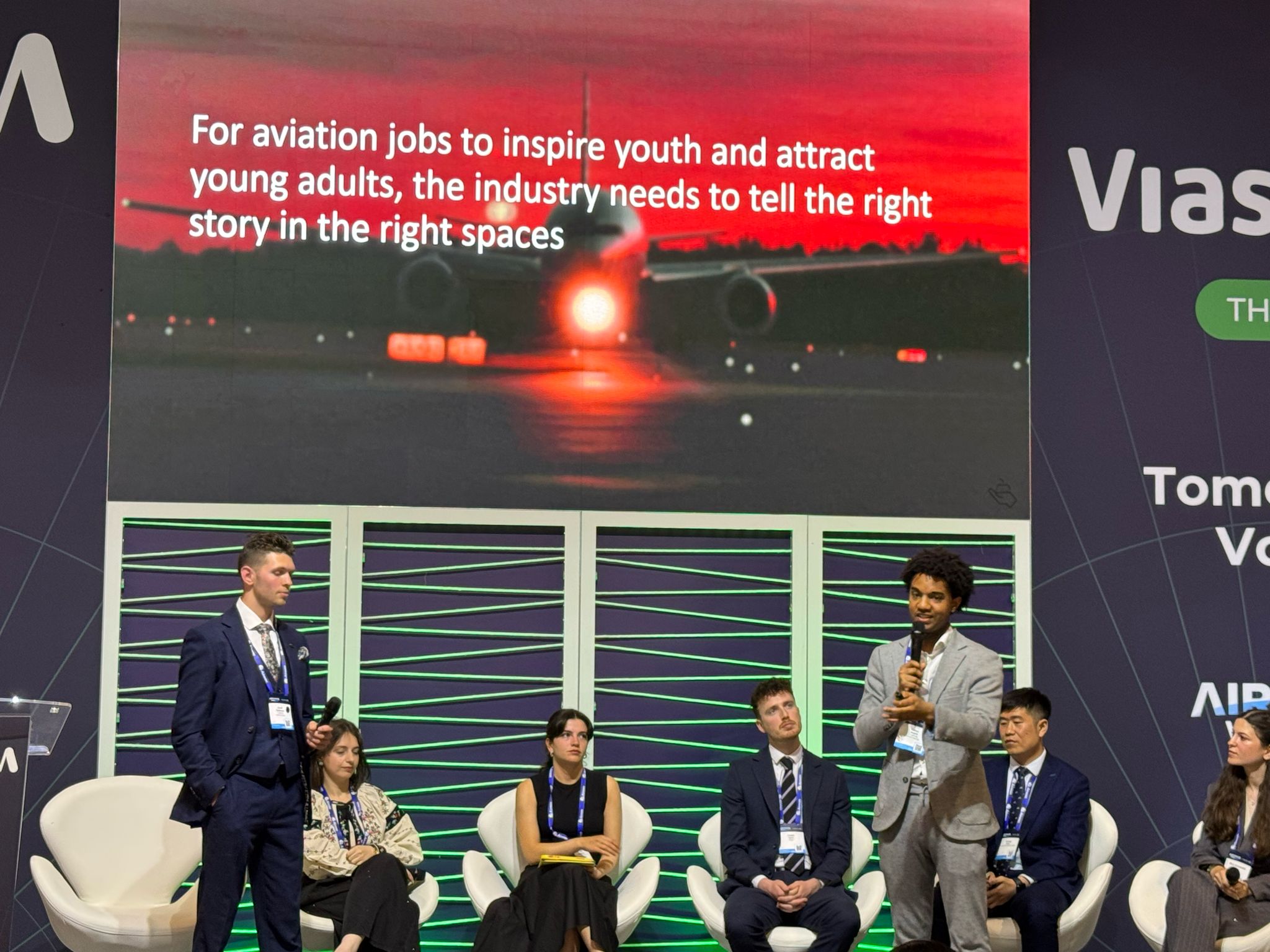
An invigorating session at the Viasat theatre highlighted the role that young talent will play in future skies.
Tomorrows Voices – The Next Generation of Aerospace: What Does the Industry Expect from You? (supported by CAAS) discussedthe need for a diverse skillset in an increasingly complex operating environment.
To an extent, it is a numbers game. Air travel will double in the next two decades and the industry will need people to service the demand. But the industry is also changing, with new technologies, innovative business models and streamlined procedures coming to the fore. That will require new ways of thinking and innovative approaches to challenges.
It was noted that “not all new ideas are good but it’s always good to have new ideas”. And this is where a younger generation will help as they use their digital-native skills push the boundaries.
The time taken to implement solutions in the industry is a concern for younger talent, however, and – with safety as a top priority – new ideas can’t always be immediately actioned. Perseverance is therefore a key industry requirement.
This brought to the fore an important point: younger generations do not necessarily think of a career in the same way as previous generations and moving jobs and industries is becoming the norm. Air traffic management often requires a specialised skillset and years of training, so a delicate balancing act is required.
One way forward is ensuring multiple pathways into the industry so that all interested parties, no matter their location or background, have an opportunity to join aviation and have a successful career. The increasing movement of the workforce could also be a positive as aviation encompasses such a wide range of abilities and interests that different backgrounds will be welcomed. Diversity in its broadest sense will be integral to the industry’s future.
But the industry will also insist that this diversity is aligned with its objectives. Teamwork was therefore highlighted as an essential skill going forward. Those coming into the industry will need to further the collaboration that already exists both within an organisation and with the wider industry. There will be a need to bring solutions to the table, but an open-minded, emotionally intelligent approach is necessary to accept modifications and improvements.
Naturally enough, skills in new technologies will be essential. This was described as “non-negotiable”. Even so, technical ability will never be the complete answer to industry needs. Rather, technologies are tools to help. Artificial intelligence (AI) will be harnessed in multiple areas, and coupled with automation, will do many of the routine tasks to help mitigate the impact of sheer traffic volume. Human oversight is still envisaged, however, and the next generation of air traffic personnel will be engaged in value-added services and making creative decisions.
Overall, the industry will demand several key attributes from new talent, including passion, adaptability, cross-disciplinary, digital fluency and sustainability awareness.
The panellists
Ben Stanley, Firstfruits Services CEO
Maria Crespo, NAV Portugal Head of Work Relations
Michiel van Dorst, Ministry of Transportation and Telecommunication of Bahrain
Civil Aviation Advisor
Mildred Troegeler, The Boeing Company Executive liaison to ICAO & Director, Global Regulatory Strategy
Patrick Ky, International Centre for Aviation Innovation CEO
Anusha Aravind, Euroavia