









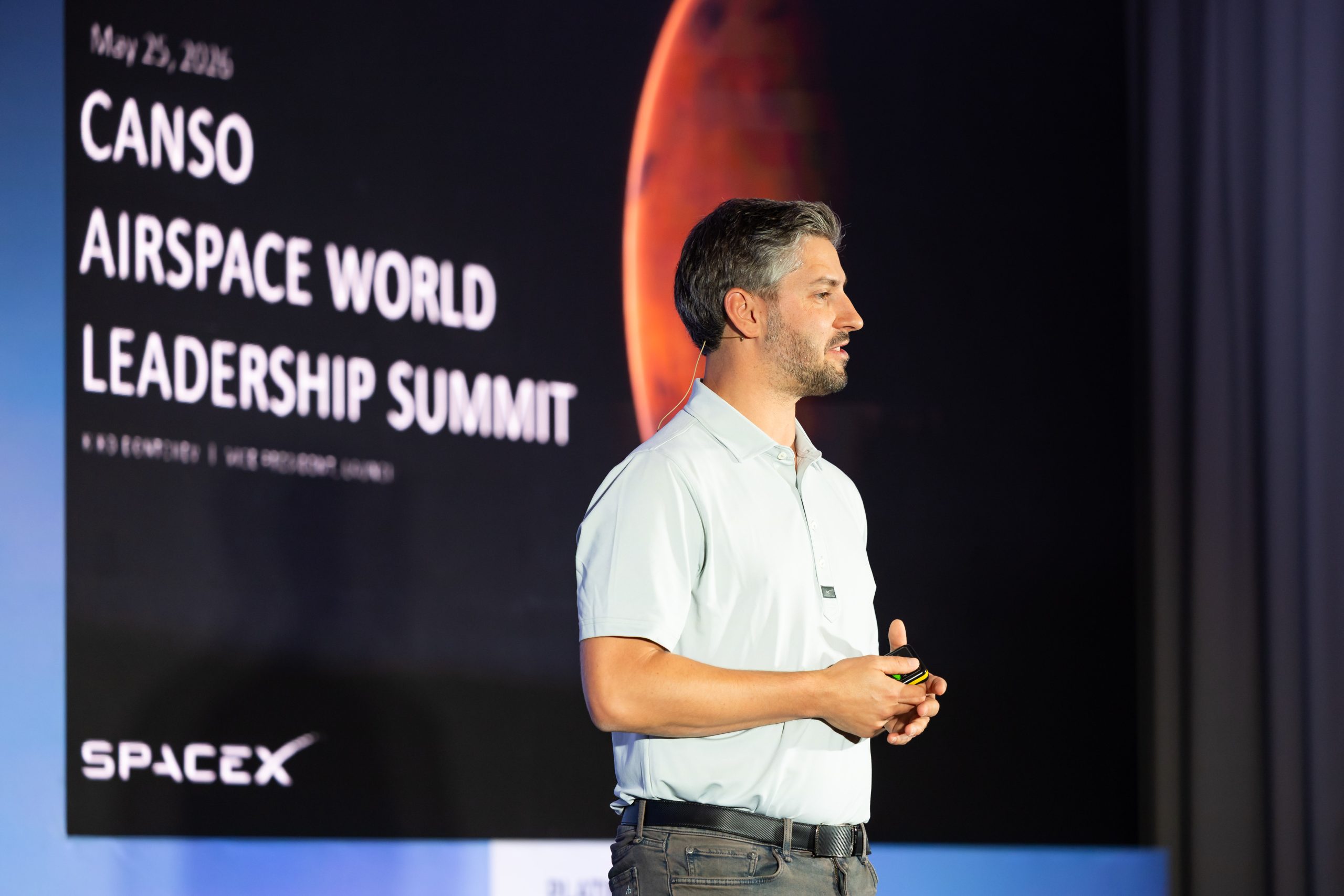
In a keynote at the CANSO Leadership Summit 2026, Kiko Dontchev, Vice President of Launch, SpaceX underscored the increasingly important role of air navigation service providers (ANSPs) as launch activity continues to rise.
The SpaceX Falcon rocket has launched more than 650 times and been reused over 575 times, with most non-reused missions occurring early in the programme. Reusability has transformed operations. In 2025 alone, Falcon launched 165 times – nearly triple its total from three years earlier.
In 2025, each Falcon launch added an average of only three minutes to flight times, while the affected airspace also continued to shrink. This reduction in disruption has been achieved through close collaboration with ANSPs.
Kiko said: “Looking ahead, that collaboration will need to deepen. Annual launches are expected to reach around 3,000 in the coming years. SpaceX will also use its larger Starship rocket more frequently. It carries roughly 10 times as much propellant as Falcon and will therefore initially require a much larger volume of airspace to be restricted.”
To guide those discussions, SpaceX highlighted a five-step strategy it refers to as “the algorithm”.
- Challenge requirements. Review every constraint carefully and remove any that do not genuinely add value, so discussions focus only on what is truly necessary.
- Eliminate unnecessary process steps. As Kiko put it, “don’t solve problems that shouldn’t even exist”. Teams should avoid spending time on processes that may not be needed at all.
- Simplify and optimise. If launches are to become routine, collaboration must also become straightforward and efficient.
- Move faster. Planning and execution should be accelerated wherever possible.
- Automate last. Automation should come only after the first four steps, since there is no benefit in automating an unnecessary process.
Kiko stressed that the main enabler will be a shift from static to dynamic hazard areas. In practice, that means treating rockets more like aircraft, with real-time communication and more precise airspace management. Today, a launch window—and the associated restrictions—might remain in place for four hours, even though the launch itself lasts only about 10 minutes. Airlines, however, must comply with the restrictions for the full window.
Much of SpaceX’s launch activity has been driven by Starlink, its satellite network providing connectivity around the world, and ANSPs have been central to enabling that growth. They will be just as important in supporting SpaceX’s longer-term ambitions, including a moon base and missions to Mars. Those goals are ambitious, but strong collaboration with ANSPs will be essential to achieving it.